
Peace on this earth?

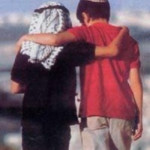
Stills from "My So-Called Enemy"
By Sydney Smith
Many organizations and programs make use of America as a neutral space to bring people on opposing sides of conflict. This seems especially true of the Israeli-Palestinian conflict where place plays an integral role.
Ori Nir (Americans for Peace Now) has a great write-up concerning the Middle East program of New Story Leadership which brings young adults to DC for internships and leadership training. Participants will eventually return to their respective homes in Israel, the West Bank and Gaza with the hopes that they will share what they have learned with their communities.
Participants in this year’s Middle East Program told their stories at a recent Capitol Hill event. One activist, Shay Zavora spoke of his moment of realization of commonality.
“He spoke about the fear he experienced growing up under the terror of suicide bombers during the first three years of the second intifada. Later, as an IDF soldier patrolling the streets of Bethlehem, he saw the same terror in the eyes of a young Palestinian child gazing at the heavily armed Israeli soldiers through his home window. That, he said, was a life-changing moment. It was a moment in which he grasped how fear governs the lives of people on both sides.” ~ Ori Nir.
A wonderful film, My So-Called Enemy by Lisa Gossels—which you should all watch if you get a chance—follows Israeli and Palestinian girls after their participation in a Building Bridges for Peace camp in the US in 2002. The film is shot over a seven year period that follows six of the girls as they navigate adulthood and reconcile the ideals of the peace camp with the realities of daily life. More than one girl mentions how much easier it is to talk about peace in America than in the Middle East where the source of the conflict, the land, is such a powerful presence.
Last week SFCG hosted an Israeli-Palestinian delegation from the State Department for a seminar. Search’s Leadership Wisdom Initiative Director was the host and he related an experience he had working with Israeli and Palestinian political leaders. He had lead them on a hiking trip through Spain. At first they were interested only in talking at each other and making sure their own points were heard (this are politicians after all) but eventually, the fact that they had to depend on each other in an unfamiliar place made two-way conversation a possibility.
What happens after events and programs that remove people from their conflict zones? The hope is always that the experience resonates and creates something that grows.
In Gossels’ film two of the girls, one Palestinian (Rezan) and one Israeli (Gal) form a strong and lasting friendship. They keep their bond alive despite the escalating violence of the second intifada. Eventually Gal joins the army and though Rezan is aware of her choice, Gal never meets Rezan in uniform. For Rezan, Gal is an individual, a friend, a sister. But the fact of the uniform remains. The fact of place remains.
Something the members of the State Department delegation said was that it is easy to relate to someone as an individual, easy to have dialogue, possible to create understanding between people, especially in neutral spaces. But this did not change underlying policies.
So…is there a limit to the usefulness of dialogue?





Comments are closed.