
Theater of the Land

Gahini--Actress Christine Uwamahoro stakes her claim to land in a dramatization of land conflict in eastern Rwanda.
By Benedict Teagarden
Rwanda, the land of a thousand hills, has stunning scenery. Perhaps even more impressive than the landscape of Rwanda, is the cultivation of this small east African country; land is farmed from the bottom of valleys to the tops of the hills. Rwanda has the densest population in Africa and relies heavily on agriculture. Therefore, land is at a premium. In this context, conflict over land can ensue.
A group of theatrical actors is touring around Rwanda, with the aim of starting conversations that seek ways of resolving conflicts non-violently. The troupe travels to rural areas across Rwanda, speaking with communities about their specific land conflicts. The troupe then improvises a play reflecting the themes of those conflicts.
The theater performances are more than just sketches of conflict—they are interactive. The audience is encouraged to take part in the performance and offer their insights about what the best approaches are for overcoming land disputes. Through humor, dancing, and serious reflection on problems within society, participatory theatre is a dynamic tool that engages local populations in problem solving. The project is run by Search for Common Ground, with USAID funding.
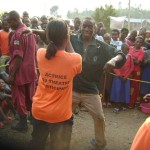
Recently, the troupe was in Gahini, Eastern Province. Through talks with local residents, the troupe learned of conflicts over land within families. After performing a sketch of a family quarreling over inequitable land inheritance, those watching in the crowd came forward to take part in the narrative and give their comments.
“Yes, we have these conflicts here,” reflected Chantal Uwimana, a resident in Gahini. About the conflicts, she “finds it shameful”, especially when seen by the youth, the next generation. Others came forward and spoke about seeing the theater as a mirror, showing the community its problems up close. Those speaking agreed that there was a need to find solutions to their conflicts. At the conclusion of the sketch, an elderly resident of Gahini stared off at the cultivated hills in the distance. Reflecting on the hills and the troupe’s performance, he mused, “the message started here, but I hope that the message spreads out to the hills where it is needed.” This is, indeed, the goal the participatory theater troupe aims for—to start a dialogue about abandoning violence as a means for resolving conflict inside local communities.
The troupe packed up the improvised stage into its van and sped back to Kigali for some sleep before heading out to another sector the next day. They will repeat their efforts at opening dialogue on non-violent solutions in the crowded, little country.
Related Posts
 Rwandan actor faces his enemy — and finds himself
 Participatory Theater Sets the Stage for Non-Violent Solutions in Guinea & Beyond
 Tackling Conflict with Creativity
 SFCG’s Participatory Theater in Rwanda Featured in Africa Peace and Conflict Journal
 The Transformative Power of Art in Peacebuilding
 Acting out (of) Conflict

Comments are closed.