
Staged Violence, Real Props?

Tanya in her DRC stage debut
By Tanya Castle
Art is an expression of culture: never have I realized this more acutely than in the Democratic Republic of Congo.
Where I’m from, children are privileged to be largely spared from exposure to everyday, real-life violence, and we try to protect them from stylized violence as well as evidenced by content ratings for television shows, movies, video games, and the like.
In the DRC, a country that is just now recovering from a drawn-out war, there is no such shield guarding children from viewing and absorbing violence, both real and imagined. Indeed, it is often youth themselves who are participating in such violence, not only in art but in real life.
Bukavu was once the theater capital of the DCR, thriving as a cultural centre during colonial times and in the years that followed. However, the onset of the war in 1998 changed things, with concerns for survival overshadowing the need for creative expression.
Now, almost ten years after the war officially ended, Bukavu is reclaiming its position as a cultural hub—at least if a talented and dedicated group of young people have their way. The 32-member troupe Ma Destinée (My Destiny) is busy writing and staging original plays, and performing traditional songs and dances across the city.
Recently, they staged a performance focused on the history of the Congo, aptly titled Fifty Years of Independence? I had the privilege of playing the role of a Belgian colonialist, an experience I can describe as a “privilege” only in hindsight. At the time, it felt much more like a punishment than anything else.
My participation in the play was prompted by Alliance, a 25-year-old law student, journalist, and actress I met while visiting a local youth radio station. I was there to solicit their participation in a Search for Common Ground initiative that works with local journalists to combat sexual- and gender-based violence.
A few hours after leaving, I got a call from Alliance soliciting me: she explained that she was looking for a white girl to play the role of a Belgian colonialist’s wife in an upcoming play she was producing. As I realized where this conversation was headed, I responded preemptively, “I am not an actress, Alliance—I haven’t been in a play since I was 10 years old!”
She assured me, saying, “Of course you can be an actress! You would be great!”
I pleaded with her, using every excuse I could think of. “I’m really not,” I insisted, “and even if I could act, I’m not a native French speaker.” She dismissed these concerns and asked if I would at least attend rehearsal and give it a try. After much hemming and hawing, I agreed to try—but just try.
My hesitation didn’t translate: the next thing I knew, my housemate was home, with the script in-hand, saying how happy Alliance and her troupe were that I had agreed to play the part of “Marie.” I took a deep breath. I would just have to do it.
I arrived at rehearsal bright and early Saturday morning and met my fellow performers, including my husband “Marco,” played by Evert, a Flemish-speaking Belgian who heads an international human rights organization here in the DRC.
Our first rehearsal was far from perfect. Within minutes, I realized that according to the script, my character is raped (in a scene off-stage), and I grew nervous thinking about my role in depicting violence. However, the director reassured me, saying we would have time to iron out the wrinkles before the opening performance, the following day at 2PM. When Evert and I left, with orders to return at 9AM, we were feeling a little more at ease.
But my nerves quickly returned when we show up for our next rehearsal and no one else was there! The rest of the cast and crew didn’t arrive until noon, giving Evert and me plenty of time to plot our escape. Ultimately, though, we couldn’t do it. We had made a commitment to Ma Destinée, and we were determined to honor it.
***
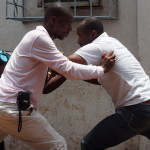
I began to realize the extent of the differences between my upbringing and that of my fellow cast-mates while in the dressing room with a Congolese teenager. He was dressed in military fatigues for his role as a rebel soldier. His character drags me, kicking and screaming, to his commander, who whisks me off stage—with the implication that I am then raped.
While putting on his costume, the boy took out a real knife, and placed it in his belt as a prop. Startled by its size and sharpness—and slightly afraid for my safety, since I could easily be cut during the scene—I gestured to the knife and said to him, “I don’t think that’s such a good idea.” He waved off my concerns, saying he’d be careful and that no one would be hurt.
But it wasn’t just my physical safety I was concerned about. I don’t like the idea of real weapons being used on-stage. It feels, somehow, like I’m glorifying or endorsing violence by acting out a dramatic scene with an actual knife.
“It’s not just that,” I told him. “It’s that children will be in the audience, and I don’t think they should be exposed to real weapons.” At this point, his fellow “rebels” are backstage, agreeing with their friend that it’s fine; it’s not a problem; I shouldn’t worry. I am feeling more and more out of my element: there’s no way a play in Canada would have real knives on-stage! I tried once more, insisting, “Children should not see weapons.” I’m met with blank stares. Finally, I say, “Weapons glorify violence.”
In unison, the boys burst into laughter. Amidst laughter one of them responded, “Glorify violence, are you kidding me?”
And suddenly I am reminded: I am in the DRC.
For youth in the DRC, a childhood permeated by weapons and violence is all-too-common —and I, the privileged Canadian, had temporarily forgotten what a sheltered life I have led.
In a play about the history of the Congo—written, performed, and produced by youth—knives and guns, rapes and pillages were featured, not in an effort to “glorify” violence, but in an effort to be honest about their history, and to serve as a vivid if unfortunate reminder about the violence that has plagued their culture.
Recently, I ran into Alliance. I asked her if there was going to be another play, and she said yes, the group is busy writing it now. She didn’t say what the subject will be, but I can only hope that this time, it will focus less on the violence their country has undergone, and choose to focus instead on a hopeful future of peace.




Comments are closed.