
For Youth, By Youth in Timor-Leste

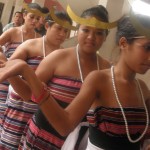
Dancers perform at the launch of Babdok Rebenta in Dili.
SFCG has been working in Timor-Leste since April 2010, where our focus has been on youth. As in many of the countries where we work, it’s not easy being young in Timor. With unemployment over 50%, future prospects can be bleak. Furthermore, young people often lack community leadership, marketable job skills and are politically marginalized.
While today’s young Timorese are the country’s most educated generation, many parents still cannot afford to send all of their children to school. And while vocational training exists as an alternative, it often doesn’t match economic opportunities available. Agriculture is the largest driver of Timor’s economy but many young people don’t think of farming as “real work” and migrate to the capital, Dili, for often nonexistent jobs.
Large scale youth unemployment always raises concerns about violence and in Timor these would not be unfounded. In the 2006 crisis, violence spiraled in the country fuelled by conflict between Westerners and Easterners in the military. In that conflict, young unemployed men were the main perpetrators of violence.
While literacy is also highest among young people, only 68% are literate in Tetum and %17 in Portuguese, the two official languages. Portuguese is still the language of government, despite not being spoken by most of the population. The re-adoption of Portuguese was an attempt to fashion a Timorese identity after the nation won independence from Indonesia, who had enforced its own language as the sole national tongue. Rather than lead to unity, however, the insistence on Portuguese has left young people feeling disconnected and excluded from the nation building process.
These relatively low literacy rates also mean that newspapers often go unread. Young people are susceptible to manipulation because they lack reliable information, often turning to rumor from peers instead. They also lack a space to express themselves.

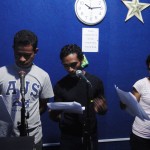
Young Timorese at the radio show's launch
We’re working in Timor to address these issues and more, and doing it with a tool we’ve come to know well: radio! We’ve begun with a Youth Radio for Peacebuilding show, Babadok Rebenta (“The Drums of Peace”), whose launch we featured earlier this year. Nine episodes of an expected 24 have already been broadcast. Working with 15 community radio stations across Timor, episodes are broadcast every Saturday.
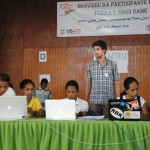
The issues that the radio show is focusing on came out of a Youth Forum we held last year. Over 80 young people, representing all 13 districts in Timor, participated in the forum. They identified areas with a need for change and their feedback has informed the curriculum of the radio program.
A reporter-presenter team work in each of the districts where we broadcast. Team leaders in the Dili office send topics in advance and produce the final 30 minute program using content supplied from the field teams. In addition to localized content, each community radio station also broadcasts its own hour-long call-in aftershow that deals with the episodes themes in a local context.
Babadok Rebenta is currently the only show by youth, about youth and for youth in Timor. Working with young, inexperienced producers has had its challenges, but listeners say the production quality is improving every day, with music and poetry being implemented along with man on the street interviews. In building a radio program, we’re also building capacity.

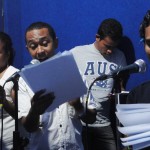
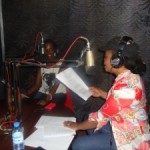
A producer does an interview for the show.
The show has already earned high praise with youth remarking that they have never heard anything quite like it on Timorese radio. They have noted, with appreciation, that it represents the voice of young people, not just in the capital but also from rural areas. Rural Timorese say that it allows their voices to be heard clearly across the country. Some of the show’s listeners are so excited that they want to spread BR’s reach even further. They want to broadcast episodes in market centers and other areas where large groups of people can hear the messages discussed.
Our goal with the show is to give youth a platform to address issues affecting them in a constructive, solution-oriented way. We also aim to bring wider awareness of youth issues and engagement so that both youth and media are seen as valuable resources in peacebuilding and managing conflict.
Babadok Rebenta gives young people a space to speak in their own words. It can be an outlet to explore frustrations as well as solutions. While not a panacea, it can help contribute to forming a national identity and let youth know that they are neither alone nor voiceless.


Trackbacks and Pingbacks
Comments are closed.