
Thousands Rally in Papua to press for Independence

Demonstrators rallying for independence in Indonesia's Papua province (Reuters/ NYT)
Earlier this week, The New York Times featured an article about protests in the Indonesian provinces of Papua and West Papua. Thousands of demonstrators, many in tribal dress, marched amid heavily armed police officers and soldiers. The demonstrators demanded a referendum on independence for the region and the repudiation of a 1969 vote that was backed by the United Nations and formalized Indonesian control.
“For 40 years the Indonesian government has never fairly applied the law or upheld human rights,” said Victor Kogoya, the chairman of the Jakarta consulate of the West Papua National Committee. “The Papuan people have never had justice.”
Papua is the largest and easternmost province of Indonesia, comprising most of the western half of the island of New Guinea and nearby islands. Its capital is Jayapura. In 2003, the Indonesian government declared the westernmost part of the island a separate province, now known as West Papua.
During the Dutch colonial era, the region was known as Netherlands New Guinea. Since its annexation in 1969, it became known as “West Irian” or “Irian Barat” until 1973, and thereafter renamed “Irian Jaya” by the Suharto administration. This was the official name until the name “Papua” was adopted in 2002. Today, natives of this province prefer to call themselves Papuans.
Indonesian governance of Papua is recognized by the UN and practically all members of the international community. Papua was a major beneficiary of a nation-wide decentralization process started in 1999 and the introduction of Special Autonomy Status in 2002. However, the implementation of Special Autonomy measures has been criticized by many as being half-hearted.

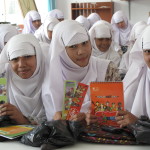
A group of Indonesian children who participated in one of Search's community-based projects
Indonesia is enjoying a period of sustained economic growth, coupled with consolidation of democratic institutions and processes. However, ethnic, religious, social, cultural and other tensions persist throughout the archipelago. Low intensity conflicts have adversely affected communities across Aceh, Kalimantan, Papua, Sulawesi, and elsewhere.
Search has been working in Indonesia since 2002 and one of our major programs in the country involves community-based conflict transformation. We have been working with communities and civil society organizations in Aceh, Bali, Java, and Papua, among others. We have implemented numerous cross-sectoral and multi-level dialogue community–based conflict transformation programs including: conflict resolution and journalism training, peace education programs in Islamic boarding schools, peace bulletins for children, prison reform, and grassroots mediation programs.
Through our focus on community-based conflict transformation, Search hopes to help find peaceful solutions so that conflicts like the one in Papua can be resolved without the use of violent means. It is only through dialogue and negotiations that various ethnic, religious and cultural groups can transcend their differences and work for a positive future for their country.
Find out what we’re doing to support conflict transformation in Indonesia!





Comments are closed.