
The SFCG Team in Nigeria Perseveres Despite Attacks in Jos

Suicide bomber strikes again in Jos, Nigeria. Photo credit: Premium Times
The following post was contributed by Lena Slachmuijlder, SFCG’s Chief Programming Officer, who is currently in Nigeria supporting SFCG’s team there. Thank you to Lena and our Nigeria staff for their willingness to share their thoughts on the recent terror attacks in Jos.
It’s Sunday morning, and Sarah Bentu is preparing to go to Church. Suddenly, she hears a huge explosion:
“I knew it was a bomb, so I just stayed inside. Later, I heard that someone I knew was at the Church. She didn’t make it.”
Sarah is the Program Assistant for Search for Common Ground in Jos, the capital of Plateau State of Nigeria, where inter-religious conflict has bred suspicion and mistrust, with Christians and Muslims living in segregated parts of the city.
Boko Haram, the terrorist movement, whose names translates to mean “Western Education is Bad,” claimed responsibility for the attacks of Churches on 10 March and on 26 February, as well as others around the north of Nigeria over recent months. They have stated that their attacks are due to ‘persecution of their members’; attacks on prisons have freed prisoners accused of being Boko Haram members. In Jos and other places, the bombings were followed by reprisal attacks by Christian youths who erected roadblocks and lynched those suspected of being Muslims.
Boko Haram’s attacks began in 2008, primarily confined to Nigeria’s northeastern state of Borno. But several factions of the sect have expanded in the past six months to operate in at least 10 states across the north, and have struck Nigeria’s capital city of Abuja. Attacks in January in the largest northern city of Kano have led to 162 deaths.
“Our work brings people together, to build trust,” explains Sarah. “We help Christians and Muslims to work against the real enemy, not each other.” SFCG’s activities in Jos bring local leaders together to identify common strategies to the fight against Boko Haram. “Christians can wrongly assume that all Muslims are behind these attacks, if they don’t have an opportunity to speak to each other, and realize that Muslims are also opposed to these attacks,” says Sarah.
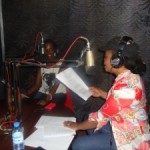
But with roadblocks around the town, bringing people together to do Search’s work is not always possible. That’s when the power of radio shines. Even when people are too afraid to leave their homes, they can listen to radio. SFCG’s work includes radio program production, and currently airing twice a week on Jos radio is a new radio drama entitled “Common Ground”.
“The drama tells the stories of ordinary Christians and Muslims, who realize that, despite the violence, they need each other to live and to prosper,” explains Sarah. “We’ve received a lot of positive feedback from people saying that it is helping them to ‘remain calm’ and think twice before encouraging retribution attacks.”
“Common Ground” is the first radio drama to reflect these sensitive inter-religious conflicts to be broadcast on the local radio station. The story lines not only create empathy across the religious dividing lines, but also model examples of addressing real grievances – be it about unemployment, corruption or marginalization – without resorting to violence.
SFCG’s Country Director Chom Bagu remains hopeful. “People are showing an enormous degree of restraint. Before, these types of attacks would lead to massive inter-community riots. The fact that this isn’t happening is due to our work of creating trust, and putting on radio important messages of tolerance and collaboration,” said Chom. “Many communities have chosen to remain united, to protect each other. SFCG’s vision is to support the many courageous Nigerians who say ‘no’ to manipulation and division, and see the longer term interest of unity. Now, more than ever, SFCG’s work is important and needed throughout Nigeria.
Comments are closed.