
Participatory Theater Provides Community-Focused Solutions

Any member of the audience can come on stage and suggest a solution to the conflict performed
By Anne-Lise Seve
An incredible palette of colors adorns the local garb, the exotic fruits and vegetables, the soil, and the trees. There are hundreds of children, women, and men smiling, laughing, bargaining, exchanging, and discussing. Everywhere there is the sharpest sense of life. This best describes a market place setting in rural Burundi.

A colorful and lively marketplace in rural Burundi
However, life there is no idyll. In rural areas such as these, conflicts are brewing. Indeed, because of its proximity to Tanzania, there have been significant population shifts in Southern Burundi caused by the different crises that have shaken the country. People fled the country, becoming refugees abroad. Some who stayed became internally displaced persons (IDPs). Now that the conflict is over they are coming back to their homelands. Their return has generated serious land conflicts. Some IDPs and refugees have found that others have occupied their lands and houses.
Two kinds of returnees can be distinguished: those who had left in 1972, when the first major clash between Hutus and Tutsis occurred, and those who left during the civil war between 1993 and 2006. Returning tends to be easier for the latter as their exile was shorter and they were often able to cross the border to verify that no one had taken their land.

A family of internally displaced persons
But for those who fled in 1972, the situation is more complex. Their land has been occupied or redistributed by local officials to other people and the Burundian civil code recognizes squatters’ rights after 30 years. Besides, many of the 1972 refugees never had proof of ownership in the first place. Therefore, when those refugees decide to come back after decades of exile, they find themselves with no land. While I was there, I was told that land conflicts are intractable because there is more at stake than just the land; the crops that squatters have sown and cannot transplant elsewhere are also at issue.
This problem is reinforced by the simple scarcity of land in Burundi. Burundi is the most agrarian country in the world, with roughly 90% of its 9 million inhabitants living in rural areas. It is also a very small country. It is therefore the second-most densely populated country in Africa and recurrently one of the poorest countries in the world.

Houses where internally displaced persons have had to live for the last ten years
Soon, a new “wave” of returnees, mostly from the 1972 crisis, is supposed to arrive in the province of Rutana in South-Eastern Burundi. According to the UNHCR, approximately 60,000 refugees are expected to be repatriated due to the closure of the Mtabila camp for Burundian refugees in Tanzania. Search for Common Ground is working to defuse potential conflicts that may arise in the face of this large-scale return. Raising awareness among the population about the need to respect the repatriated, SFCG has recently carried out a participatory theatre tour across the province.
The way participatory theater functions is pretty incredible. Participatory theatre is an original and unique tool to solve conflicts within a community. What makes it so special is the emphasis it places on representing the realities where the performance takes place. Even more unique, it involves the local population in the performances.
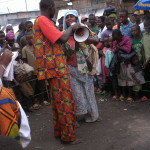
The ritual is always the same. SFCG’s team and actors arrive at a market place. Then they set up a stage and start gathering people (although they naturally come around, intrigued by the newcomers). Prior to each performance, actors collect information from the local population to identify the most pressing issues they face. In this case, of course, land issues were highlighted. After interviewing people from different groups as well as local authorities, they develop short plays based on the issues raised. This type of theater performance provides the participants with a means to break local taboos, generate dialogue, foster mutual understanding, and find common ground solutions.

The end of the performance always ends up with the characters getting into a big fight
Although each performance I attended was different, the core plot remained the same: a resident’s family is disturbed by the return of a returnee’s family and at the end of the performance they get into a big fight. This fight always triggers a response from the audience. It is at this moment that a mediator comes in to stop the fight and asks to the audience what solutions can help transform this conflict.
Members of the audience can then step in, give their point of view and share their experiences with land conflict. People can also decide that if a character wasn’t played well or if characters could have acted differently to avoid the fight, the scene can then be played again with the audience member. After each suggestion, the rest of the audience has to agree with it. If this doesn’t happen, someone else comes in and makes another suggestion and this goes on until everyone agrees with the way the conflict should be solved.

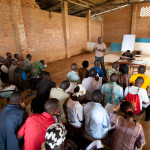
An audience captivated by a theater performance
It was very impressive to see the audience captivated by the play. People laugh, think, and engage with the actors. This is why participatory theatre is such a good way to solve conflicts and raise awareness about conflict resolution within communities. It provides a forum for communities to discuss the conflicts they face as well as possible solutions in an entertaining format. In order to solve a conflict people need to feel that they have to act differently. Imposing such behavior on someone does not work if the person is not convinced it is the right thing to do. This is a problem that big international institutions and NGOs often face. They have a global vision of a problem when they should have a local one.
It is crucial that solutions to local problems be understood and addressed by local people themselves, because each conflict is different. Solving a conflict therefore requires focusing on each community. Participative and inclusive ways of solving conflicts that involve the local population have a greater chance of working. Participatory theatre ensures that the people are involved. As local audiences have said, it has helped them to better understand the way they can avoid conflicts when returnees begin to arrive.
Anne-Lise Seve is pursuing her M.A. in International Politics at Sciences Po Bordeaux in France. She recently served as an international intern with Search for Common Ground Burundi.

Comments are closed.