Members of SFCG’s participatory theater troupe performing skits with students in Rwanda.
By Ashley Murphy
Popularly known as the land of one thousand hills, Rwanda’s natural landscape is green and luscious despite being cultivated and heavily populated. As I traveled into Northern Province’s Rulindo District to visit a secondary school as part of SFCG’s unity and reconciliation project, I could not help but envy the students in residence. The setting of their education seems idyllic; the school is nestled into green mountains dotted with trees. Colorful birds call from the bushes, a rushing river flows nearby. The students seem to have correspondingly idyllic lives; during their lunch break I observe them holding hands, telling secrets, wrestling, lifting weights they fashioned from old milk cans. Yet just as each rolling hill holds its own story of turmoil from the 1994 genocide, each of the students harbors a private story. Many have lost family members, or are the children of perpetrators or survivors. While most are too young to have experienced the genocide firsthand, they experience the residual effects every day. read more…
Emna Ben Yedder: Doing her best to empower Tunisian citizens

Emna Ben Yedder, SFCG intern with Partners in Humanity program.
Interviewed by Audra Gustin, SFCG Communications Intern
In Tunisia, Emna Bed Yedder is a manager in Mergers & Acquisitions, working in an investment bank called Swicorp that operates throughout the MENA region. In her second life, as she puts it, she is also an activist working with an NGO she helped found ACT – Think & Decide. Along with 5 other NGOs and independents, ACT has implemented a project in Tunisia called Bus Citoyen, which focuses on raising political awareness among citizens and encouraging civil society participation in the democratic transition process and the constitutional writing process.
Like Dala Ghandour, she is also a part of the Leaders for Democracy Fellowship Program. She has been interning with the SFCG Partners in Humanity program with Juliette Schmidt for six weeks. Sadly, her last day with SFCG was yesterday. Thank you to both Emna and Dala for their many contributions to SFCG during their time with us.
How did you come to be a part of the Leaders for Democracy Fellowship Program?
The MEPI Office at the US embassy in Tunisia contacted me to promote my application to the program. They knew me as MEPI was one of our funders for the Bus Citoyen project and I am the treasurer of this project, so we interacted quite a lot. I am pretty involved in Tunisian civil society; we are doing the best we can to participate to the success of this transition and to empower citizens. Being an active part of civil society has become a passion of mine.
How do you feel your internship with the Partners in Humanity at SFCG will help you achieve your goals?
I really like working on conflict transformation projects here at SFCG, projects that look for the commonalities in societies and try to decrease divisions. read more…

By J. Zel Lurie, San Diego Jewish World
Bilingual education is one of the many tools SFCG uses to progress community peacebuilding. SFCG’s unique bilingual and multicultural preschool project, Mozaik, has been hugely successful in Macedonian public kindergartens and was recently officially adopted by the Macedonian government. Similar to Israel, education in Macedonia is highly segregated based on ethno-linguistic criteria but the Mozaik project brings together children from Albanian, Turkish, Serbian, and ethnic Macedonian communities. The following article about similar efforts between Arab and Jewish communities is by veteran journalist and long-time friend and supporter of SFCG, Zel Lurie. It is re-posted with permission from the author and the San Diego Jewish World.
I have a great-grandson in Palo Alto, Calif. He attends a public school where the teachers began talking Spanish to the kids in kindergarten. Now as he finishes second grade, his Spanish is as good as his Hebrew, which he picked up in two summer camps in Israel.
English-Spanish bilingual schools are not uncommon in California. They do not have the problems that confront the five Israeli bilingual schools. The Israeli schools — and they are in Jerusalem, Beersheba, Kfar Kara, the Galilee and the original one in Neve Shalom/Wahat al-Salam — have the problem of teaching kids who come from separate communities who were at war 64 years ago and who have two separate narratives of what actually happened. read more…
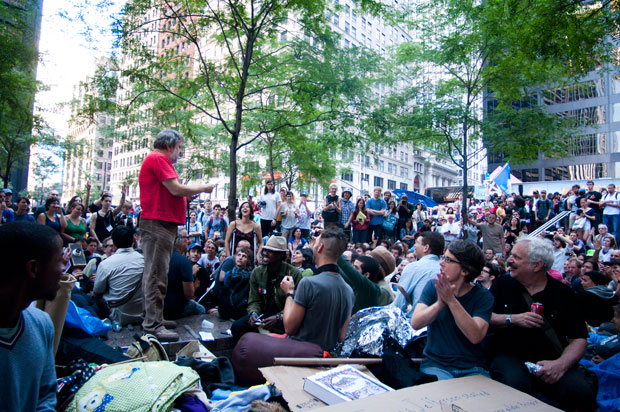
Slavoj Zizek speaks before Occupy Wall Street protesters Oct. 9, 2011. (Photo courtesy of Sarahana, The Parallax)
By: Christopher White
The problem with experts
As the movement was in its early stages, Occupy Wall Street played itself out as a living embodiment of the ideal of democracy. Zucotti Park, with its workshops on high finance and its improvised libraries, began to resemble the ideal of the Greek agora, a space where citizens could come together to freely exchange their ideas. The movement began to draw semi-celebrity thinkers and activists who spoke before the demonstrators.
One of the more interesting speakers was Slovenian philosopher Slavoj Zizek. While many in the occupy movement and The Left more generally tend to view the tea party as a stumbling block in contemporary American politics, he advised occupiers to see the tea party as a sister movement. Although he didn’t have anything positive to say about them, the crowd, using the improvised “human microphone” technique of amplification, was forced to repeat these words that they may not have agreed with: “don’t look at them as the enemy.”
Some could brush this aside with an easy cliche frequently heard when talking politics in DC that runs something like this: “the further out you go on the political spectrum, the more similar both sides become.” The subtext of this remark is that, if you’re not a pragmatic moderate, you’re crazy. Zizek, however, meant something else. read more…
Moving to the Same Beat: Festival Bolsters Repatriation of 81,000 Congolese Refugees

Bobas, Lobalas and Monzombo artists, united in song and dance, celebrate the return of their previously Congo refugee brothers and sisters.
The following article was written by Gervais Koffi Yao, Head of SFCG’s office in Dongo, DRC.
Under the three-way agreement signed by the Republic of Congo (RoC), the Democratic Republic of Congo (DRC), and the United Nations High Commissioner for Refugees (HCR), the repatriation of 81,000 DRC Congolese, who had been refugees in the Republic of Congo (RoC) since 2009, began on May 5, 2012. The first convoy carried 79 people to the center of Dongo in the Kungu Territory.
An important event for Équateur Province, SFCG organized special cultural and sporting activities in Dongo on the 5th and 6th. The first of these cultural activities included performances from the Enyélé, Munzaya, Bomboma (Bokonzi) and Monzombo folk groups from Dongo, who all put on interesting artistic shows for the large audience. read more…

Dala Ghandour with supervisor Jeanne Isler, Project Director of SFCG on Race.
Interviewed by Audra Gustin, SFCG Communications Intern
Dala is a lawyer specialized in family status legal matters and a certified mediator, offering mediation services to the unprivileged populations in North Lebanon, Lebanese prisoners and as a family mediator for divorced couples in Beirut Sharia Courts. She aims to introduce mediation into the legal system and spread this culture of forgiveness and reconciliation in the Lebanese society.
Further, in the interest of empowering youth and women to participate in their own political process, she ran as an independent candidate for Beirut municipality elections in 2010. As she says, “I believe that politics should not be only left to politicians!”
She will be interning with the SFCG Race Project with Jeanne Isler for six weeks, ending on June 8th.
How did you come to be part of the Leaders of Democracy Fellowship program?
“I feel very lucky that I’m part of this.”
“LDF is a program that gathers 20 Arab leaders from the Arab world, as Arab activists; [it] takes us to Maxwell School at Syracuse University for a month so we learn about public administration, public policy, and of democratization and so on. Then we come and we apply what we have learned in one of the different NGOs in Washington,DC… read more…