
VOICES FROM THE FIELD: Alexandra Jacobs in DRC
Alexandra Jacobs is a intern with Search for Common Ground Democratic Republic of the Congo (DRC), known locally as Centre Lokolé
In the wildly successful American musical Rent the protagonist declares “The opposite of war isn’t peace, it’s creation!” It wasn’t until my time here in Eastern Congo that I began to agree with this statement. Search for Common Ground’s (Centre Lokole in DRC) participatory theatre program has shown me the power of creativity in a conflict zone.

Photo from Flickr used under a Creative Commons license.
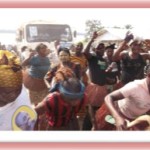
Here in Bukavu we recently celebrated World Refugee Day, an event that is especially relevant in this part of the country. Repatriated refugees must confront the social and economic challenges of returning to their country, while others are simultaneously fleeing their homes as rebel and national armies alike continue to wreak havoc on rural communities, creating new groups of internally displaced persons (IDPs) on a daily basis. When asked by UNHCR (United Nations High Commission on Refugees) to put together a commemorative presentation for the event, Centre Lokole bypassed speeches and statistics and instead sent a local youth drumming and theatre troupe to a section of Bukavu that has recently received a new group of IDPs. The drummers, ranging in age from 8 to 18, played with electric abandon, and spectators clambered up into trees to get a better view.
Yet what was truly exceptional is what happened when the music stopped. Five of the drummers put down their instruments to begin the theatre installment of the event, a sketch in which they depicted a former refugee returning to a community that is less than thrilled to share its limited resources with a newcomer. The characters argued about sharing access to water, housing, and whether or not community members should trust someone from a different region and who is of a different ethnicity. Just as the tension was rising, and the actors’ voices grew agitated, and audience members’ eyes began to widen, the troupe’s leader ran onto the dusty patch of ground that had been transformed into a stage and yelled “STOP!”
What followed illustrated the real power of the creative process in the context of conflict. The troupe leader summarized the action that had taken place and then appealed to the audience. Who is willing to give some of these characters some advice? Slowly but surely hands started flying up. Some children timidly voiced their opinion about how the refugee should be treated more fairly. Some others boldly stepped onto the stage area and moved the actors around, putting them in perfect position to heed the proffered advice. When the troupe leader gave the signal to resume action, the energy in the audience had changed. Everyone leaned in a bit more, and those who had shared their opinions wore expressions of invested interest. The performance was now the shared property of both the performers and the audience, for it was the audience members who had crafted its conclusion, in which the refugee was ultimately treated with respect. This feat of creativity was a two pronged attack against the damaging effects of war.
Contributing audience members were inhabitants of a community that has seen refugees and IDPs come and go for over 10 years, and may have been displaced people themselves. But the dynamic performers had also seen their share of destruction. Many of the drummers had escaped lives as child soldiers or child prostitutes in the service of armed groups. Their bodies had once been manipulated to serve the desires of forces corrupted by years of conflict. But on that day their bodies were their own; they were free to beat their drums together, dance together, and act together. Peace is certainly still the opposite of war, and the objective behind much of Search for Common Ground’s work. But participatory theatre proves how creativity can help pave the way towards that ultimate goal.
Related Posts
 Democratic Republic of Congo: Past. Present. Future?
 Congo: Tackling child exploitation in schools
 Return in Peace: Addressing the Rwandan Refugee Crisis (Retour en Paix: Faire face à la crise des réfugiés rwandais)
  Participatory Theater Sets the Stage for Non-Violent Solutions in Guinea & Beyond
 Moving to the Same Beat: Festival Bolsters Repatriation of 81,000 Congolese Refugees
 The Transformative Power of Art in Peacebuilding

Comments are closed.