
Peace meets Human Rights – Nobel Laureate Liu Xiaobo

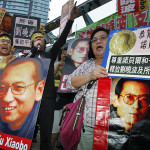
A man walks in front of a poster of Liu (Odd Andersen/AFP/Getty Images from npr.org)
In October the Nobel Prize Committee announced that it would honor Liu Xiaobo with the 2010 peace award. Today, appropriately International Human Rights Day, that award was given to the Chinese dissident in absentia as he is currently in prison.
Before placing Xiaobo’s prize an empty chair, the Chairman of the Nobel Committee, Thorbjoern Jagland said:
“We regret that the laureate is not present here today. He is in isolation in a prison in north-east China. Nor can the laureate’s wife, Liu Xia, or his closest relatives be here with us. No medal or diploma will therefore be presented here today. This fact alone shows that the award was necessary and appropriate. We congratulate Liu Xiaobo with this year’s peace prize.”
The prize has been awarded in absentia only once before: in 1936, when Nazi authorities prevented German journalist and pacifist Carl Von Ossietzky from travelling to Oslo.
We spoke previously on the connection between peace and human rights but in light of today’s ceremony and the importance of the subject, it’s worth returning to. Most notably it bears pointing out that human rights and peace do not necessarily go hand in hand—after all a dictatorship can maintain order and still violate basic freedoms. In post-conflict societies the choice between peace and justice is rarely clear-cut. In Afghanistan, for example, the push to included Taliban leaders in the new government has angered many who claim such an act might bring peace (at least temporarily) but no justice, thus allowing anger and tension to simmer.
Search for Common Ground knows all too well that the denial of human rights, especially by one group over another, can lead to serious conflict. The need to uncover the truth and achieve some measure of restitution must be balanced against the need for reconciliation. This need not put human rights and conflict resolution against each other. As SFCG Vice President, Steve Utterwulghe aptly put it, “victims of conflict and human rights abuses will be better off it human rights advocates and peace workers join their strengths while keeping their unique identities.”
Because human rights concepts are often not well understood in post-conflict societies (and indeed their abuses are often a catalyst for conflict) part of the common ground approach is to promote a common understanding that is accessible and culturally appropriate to the countries in which we work. In Chad, for example, this meant working with the military to strengthen their capacity to recognize, monitor and address human rights violations. In Burundi, we have worked with communities to develop their abilities to adequately facilitate disputes. In the DRC a major focus has been addressing sexual and gender based violence. Here we have worked with soldiers to raise awareness about what constitutes rape and its devastating impacts. Human rights are integrated into our training and media-based interventions.
What we don’t do, is advocacy. In our work, it is important to remain as neutral as possible in order to build trust and relationships with all the parties with whom we are working. However, this doesn’t mean ignoring abuses. In places where news is often rumor and/or manipulated the mere act of unbiased reporting can help create pressure for accountability.
Often change cannot come without advocacy and peace cannot be sustained without reconciliation. Therefore we hold human rights as a cornerstone of democratic, peaceful societies. At the end of the day, we have the same goal: a more humane world.
The Nobel committee has a long history of honoring those who work for peace through the path of human rights including,
Martin Luther King Jr., Nelson Mandela & Frederik Willem de Klerk, Wangari Muta Maathai, Kofi Annan, Médecins Sans Frontières, Aung San Suu Kyi, Ferdunand Buisson, Albert Lutuli, René Cassin, Amnesty International, Adolfo Pérez Esquivel, Elie Wiesel, Rigoberta Menchú Tum, Kim Dae Jung, Jimmy Carter and others.
Who else has fused human rights and peacebuilding? How do you see the two fields working together and how might they be opposed? Can a choice be made between the two?
Related Posts
 Happy Human Rights Day!
 Peace, Human Rights and The Nobel Peace Prize
 MUSEUM IN US TO SHOWCASE CHINA’S FORCED LABOUR CAMPS
 Common ground at the Olympics
 International Women’s Day: Women Empowerment and Mainstreaming Gender Issues in Peacebuilding
 Black History Month in the 21st Century: Sharing a Room, Sharing a Country, Sharing a Vision

Comments are closed.