
Bahrain: Interview with a Young Activist


Last week, SCFG hosted a “Brown Bag” presentation by Ahlam, a Bahraini activist currently completing a fellowship in the US. As part of her fellowship, Ahlam has been working with SFCG’s Partners in Humanity program. She spoke about the recent protest movement in Bahrain, in which she took an active role, and described the situation facing her country.
Bahrain is a small island state located near the western shores of the Persian Gulf. It is a constitutional monarchy ruled over by the Al Khalifa royal Family . Formerly an emirate, Bahrain was declared a kingdom in 2002. The country has a Shia Muslim majority of 70% and Sunni Muslim minority of 30%. However, the royal family is Sunni and there is much discrimination against Shias. For example, in an attempt to change demographics before the formation of parliament, Bahraini passports were given to Sunni foreigners.
The protests began on February 14, 2011. The protesters had several major goals including political reforms (Bahrain has had the same prime minister for the past forty years), an end to discrimination against the Shia, and an end to land stealing by the government (90% of the beaches in the country are privately owned by the royals). Initially the protesters did not call for an end to the monarchy, but after a deadly night raid on February 17 which killed five people and wounded 231, activists began to demand the resignation of the king.
The government imposed a brutal crackdown on the protesters. 31 people were killed and over 2,000 people were dismissed from work for participating in demonstrations. 34 Shia mosques were destroyed and 300 religious institutions were damaged. Doctors were a particular target because they had refused the government’s orders not to treat injured protesters.
Ahlam was personally involved in the protests, taking leave from her job in order to participate. She described what she had witnessed, particularly noting the strong involvement of women in the demonstrations. Describing the festive feeling at the Pearl Roundabout and the sense of humor of the protesters, Ahlam said this display of humor did not mean that the activists were not serious about their demands. “This sense of humor was just to ease our pain,” Ahlam explained.
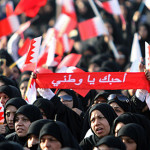
She also spoke of the overwhelming sense of community among the demonstrators and their determination to make sure that the revolution did not have a sectarian character. One of the most popular slogans of the protesters was “No Sunni, No Shia, I am Bahraini.” It was the desire of the protesters to unite all citizens who loved their country, Ahlam said, regardless of whether they were pro-democracy or pro-government. To show their solidarity with all Bahrainis, the protestors formed a human chain from the Pearl Roundabout, the base of the largely Shia pro democracy demonstrators, to the Grand Mosque, the stronghold of the mainly Sunni, pro-government demonstrators.
Despite no training in civil disobedience, the tenor of the protests was markedly peaceful. It was as if they had all decided that the only way to make lasting change and the only way to bring a sympathetic international eye to their struggle was to use non-violent means, Ahlam said. This was in spite of government efforts to incite a violent reaction from the demonstrators. Government thugs were paid to be in the middle of crowds and to cause problems.
In past demonstrations, protesters, especially young men, often vented their anger and frustration through violence; burning tires and destroying property. Ahlam recalled one day when the police purposefully left a vehicle in the middle of the square. Their hope, she surmised, was that the protesters would vandalize the car and give the police an excuse to use physical force. Yet this time there were no burning tires or broken windows. Instead the protesters simply wrapped the Bahraini flag around the vehicle and let it be.
Working at Search has influenced her perspective and she reflected on the conflict between standing firm on her pro-democracy beliefs and finding ways to engage constructively with those who do not share her position, saying, “I am firm on what I believe but soft with those I deal with.”
“It’s important too,” she said. “That there are people in the middle. Some organizations need to be in the middle.”
Although the government officially ended 11 weeks of martial law last Wednesday, the crackdown continues. But the protests continue as well, and just as important, they continue peacefully.
The following picture was recently posted on 1001 Stories of Common Ground. It’s from an initiative called the Balloon Revolution, where demonstrators release balloons in the air with messages on them. This one says, “Brothers Sunnah and Shia, this land we shall not sell.”


A young protester hands a rose to a policeman

a woman stares down police while holding the Bahraini flag
Related Posts
 Connecting & Learning: Young Tunisians Discuss Peacebuilding with SFCG’s Senior Leadership
 Democracy Begins with the Right to Speak
 Bahrain sentences 8 activists to life in prison
 Make Sure Women can Lead in the Middle East
 Building Peace In Iraq
 When opportunity knocks: A young girl’s rise to Vice Mayor

Trackbacks and Pingbacks
Comments are closed.