
Tomorrow is a New Day: Meeting with the FARDC in Kinshasa

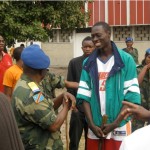
Soldiers of the FARDC attending a sensitivity training session
By Ilunga Kalala
“Is this the Congo River?” I asked as we drove down Avenue de la Montange en route to l’État Major Général (FARDC Headquarters in Kinshasa).
“Yes, it is” my colleague responded.
I had been in Kinshasa for two whole weeks and that was the first time I saw the Congo River. Ideally, I would have taken a moment to give it its due deference, to consider its depth and power (it’s the deepest river in the world with enough hydroelectric power to provide electricity to several countries in Southern Africa). However, my mind was elsewhere. In a few minutes, we would be meeting with the Forces armées de la République Démocratique du Congo (FARDC) about Lobi Mokolo Ya Sika (“Tomorrow is a New Day”): Search for Common Ground’s program to strengthen the human rights performance of the FARDC.
Admittedly–and like most Congolese–the sight of someone in military uniform gives me pause. While there are no doubt upright soldiers, the FARDC have a reputation for abusing authority and human rights. The dividing line between the policing power of the FARDC and that of the Congolese National Police has been blurred. Because military camps are located within Kinshasa, the second most populated city in Sub-Saharan Africa, there is greater likelihood for discord and thus a great need for the Lobi Mokolo Ya Sika program.
FARDC headquarters are located at the top of a mountain. Along the road, we passed what was once President Mobutu’s personal tourist site, a vast expanse that now holds the National Museum of the Congo. Five guards were seated at the threshold of the military complex. As our vehicle approached, they stood at attention with arms raised in salute. Our ascent continued for several hundred yards until we finally arrived at our journey’s end: l’État Major Général.
Once inside the building, we had to climb higher still. The building is six stories high and houses the Ministry of Defense along with other key offices. When we finally entered the room where our meeting was to take place, I found myself completely surrounded by men in military fatigues, their shoulders adorned with insignia of different colors- some with spears or stars stitched on, others with leopard heads or star brass pins.
Before the meeting began, we stepped out to meet General Mwati, deputy to General Mohamed Bin Mulubi, who heads the Civic and Patriotic Education Service of the FARDC and was absent due to travel. General Mwati explained that the Congolese army had a Civic and Patriotic Education Service designed for the sensitization of the FARDC. Yet he acknowledged that the FARDC needed help and that they were grateful to any organization that offered support.
Three committees were represented at the meeting; the 10th brigade, le Unité rattaché et régiment de GR (URATT), and the Régiment honoré et sécurité. Each Committee comprises 9 members who have undergone sensitivity training by SFCG. Each committee convenes to organize and plan sensitivity training for the units under their purview.
One by one, the committee heads recounted the impact of “Lobi Mokolo Ya Sika” on their respective brigades and the type of support needed to further it. The sensitization committee for the 10thBrigade reported that since the implementation of the program there had been a reduction in the number of military offenses reported and not a single case of rape had been reported. Moreover, there was a marked change in the civilian attitude towards Camp Ceta, a camp notorious for bad military-civilian relationships. The sensitization committee for URATT likewise reported a reduction in military offenses reported. They also reported that one consequence of the program, which may have been overlooked but was quite important, was the amelioration of relations amongst the various branches. The President of URATT said that branches now great one another with the phrase, “Lobi Mokolo Ya Sika.”
The meeting ended with a hopeful air and a notebook full of next steps. Several joint activities will be undertaken in the coming weeks. The hope is that slowly but surely the presence of the FARDC will mean something different for the Congolese people, with each tomorrow providing a new day for change.
#####
Ilunga Kalala is an international intern working with SFCG in the Democratic Republic of Congo. He is currently enrolled at Washington University in St. Louis School of Law. Find out what else we’re doing in DRC!
Trackbacks and Pingbacks
Comments are closed.

This is great stuff cuz, keep up the great work!!