
Updates from a New Country

Raising the national flag of South Sudan (myvistingcard.com)
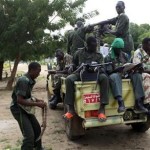
The Republic of South Sudan became the world’s newest independent nation earlier this month. However, while people are celebrating in Juba, the new nation’s capital, fighting continues in South Kordofan, a disputed border region which is technically part of the North. The Northern government, based in Khartoum, has been conducting a campaign of terror against the Nuba people, who they see as rebels, as well as against the soldiers of the Sudan People’s Liberation Army. Al Jazeera’s People and Power program conducted interviews with people from the region as well as with Abdel Aziz Adam Al Hilu, the regional leader of the SPLA. Abdel Aziz told the reporter that, although the SPLA accepts that South Kordofan will remain part of Northern Sudan, their aim is a restructuring of the central government so that people from all regions can have a larger share of power. If this restructuring fails, than the SPLA will have no choice but to fight for their right to self-determination.
SFCG has recently started working in Sudan, focusing primarily on strengthening local capacities to address human rights in South Kordofan. In partnership with the Badya Centre for Integrated Development Services, we aim to strengthen the capacity of civil society organizations, including NGOs, local associations, media and theater groups that are active in the border region on human rights and human rights protection. In addition, we will create opportunities for the targeted groups to apply what they have learned to address human rights in the region
In the past year, SFCG carried out a Civil Society Assessment to determine the different civil society organizations operating within the target area and their strengths and weaknesses in regard to engagement and involvement in the community. Additionally, the assessment helps provide a better picture of civil society’s role in Sudanese society, their relationship with the government and the population, as well as illustrate their methods and best practices.
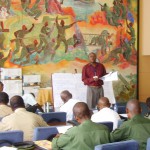
Aside from conducting the assessment, SFCG has carried out a series of workshops and trainings around capacity building and peacebuilding that targeted various members of civil society in the Nuba Mountains. These events focused on addressing some of the central conflicts taking place in the region, as well as introducing key techniques like problem solving, negotiations, dialogue, and brainstorming to help build a peaceful co-existence among the different communities in the region.

Kadougli Station Staff members (left) with SFCG's Africa Program Assistant (right) in production studio
We have also prepared to train journalists in employing common ground methodology, beginning with staff at the Kadougli radio station. They will receive training to improve their production as well as their ability to produce programming addressing issues of social conflict and human rights.
SFCG and the Badya Centre have also been preparing to work with local theater groups and introduce them to new interactive techniques used by our participatory theater programs in other countries. This has been an especially useful tool in the great lakes region. In preparation for this effort, the director of the Badya Centre accompanied SFCG’s Sudan country director and SFCG staff from our Great Lakes offices to a regional peace festival in Rwanda, which featured innovative theater performances which addressed a wide range of social issues. From there, they traveled to Burundi, where we’ve had a vibrant participatory theater program for years. They attended theater performances, and met with our local staff to get a stronger understanding of how theater can be used to foster dialogue around various conflicts and how such programming could be used in a Sudanese context.
Through our various initiatives, Search hopes to help improve the human rights situation in South Kordofan and help communities in North and South Sudan heal from the long conflict and civil war.
Comments are closed.