
Meena’s revelation: from advocacy to peacebuilding
By Jessica Murrey
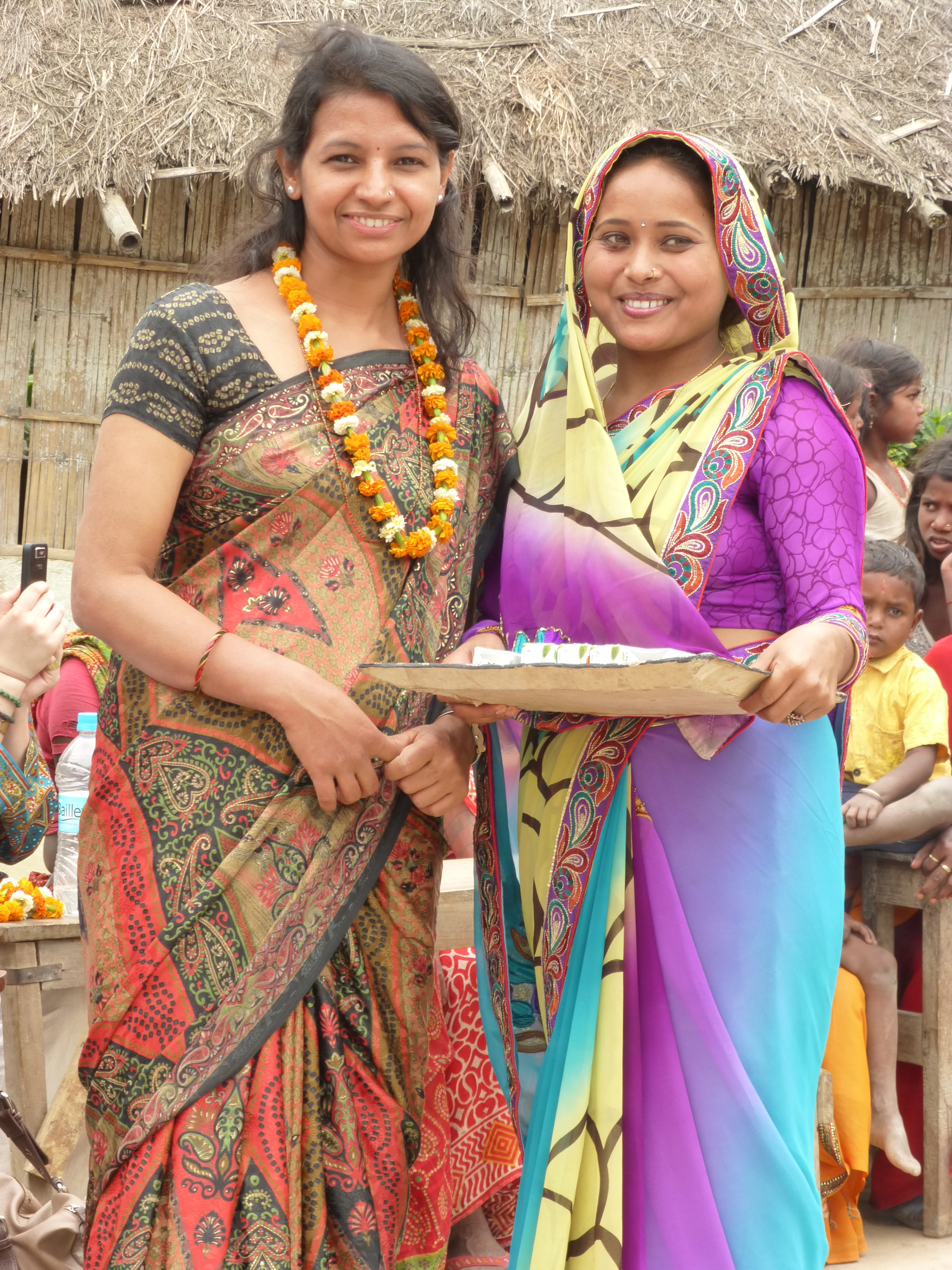
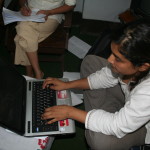
Meena with a participant in a peacebuilding program.
It was eight years ago.
Meena was making dinner when she heard a reporter announce horrific news on the TV. There was another massacre in a nearby village.
Nepal was in a state of emergency. Killing and violence between ethnic groups occurred daily, making Meena’s job a grim one. She worked as a human rights defender, tasked with surveying the damage. She tried to prepare herself for what she’d find there tomorrow, unaware that it would change the course of her life forever.
That next morning, she set off for the village with her colleagues. She was assigned to survey and report on how the fighting affected the women in the village. As they got closer to the village, she could see black smoke reaching toward the sky.
“When I got to the village there was a very bad smell, just a terrible odor, and complete silence. The only noise was children playing with the leftover bullet shells in the street,” said Meena.
One of Meena’s duties was to count the number of dead. A man led her into a large room. The bodies of the deceased were piled high. All Meena could see was the color red. She struggle to separate and count the bodies. Nausea threatened to overcome Meena. So she stepped outside to get a breath of fresh air.
There was sadness all around. A group of women mourned their children. Men quietly worked through the rubble, picking up the fragments of their lives.
Suddenly the somber stillness was interrupted by angry shouts. “This is all you fault! You’re the reason lost my son. You’re the reason I lost my house. You are cursed,” they yelled.
Meena walked towards the shouting to see who they were yelling at. There stood a woman standing with a baby in her arms. She said nothing. Her head hung low as she shuffled past her angry neighbors.
Meena followed her into the woman’s charred house. She looked like she was in her early 40’s, but she was actually only 28. Meena learned later that she had been forced to marry when she was 11, which was a common practice in this area.
Meena asked the woman why the villagers blamed her for the attack. The young mother had a hard time talking, but finally explained that just two hours before the attack her baby boy was born at home. They proudly announced it to all the villagers. It was only moments later the attacks followed. Due to local superstition, the villagers believed the baby brought with him bad fortunes on the village.
She then went on to explain the gruesome events of the attack. Her father-in-law was the first to answer the door. This was an ethnic battle, and he tried to explain that his family wasn’t part of the minority group they were hunting. They shot him down in front of the young woman. When woman’s husband tried to stop them, they shot him too and lit the house on fire.
The young woman broke down one of the mud walls and ran for her life, to a friend’s house. But in the chaos, she left her baby in the burning house.
Early the next morning there was a knock on the door. It was a woman– one of the fighters who had attacked the village. In her arms was the young mother’s baby. She handed the baby to the mother and turned to walk away. When she turned the mother saw the fighter’s back. It was crimson, riddled with bullet wounds.
She had run into the burning house when she heard the baby crying. She pulled the baby close to her chest and used her back to shield him from the bullets coming from the helicopters above. She protected him and kept him alive throughout the night, and once the fighting stopped, found the house where the baby’s mother was hiding.
She died shortly afterwards. She gave her life to save her enemy’s child.
Among all the wreckage and despair, Meena had found a glimmer of light, a glimmer of hope in this story. That even in the darkest times enemies could find within themselves the common humanity to save a child.
“I knew then that I no longer wanted count dead bodies as an activist. I wanted to build peace–to find and share hope,” explained Meena. “That’s why I came to work for Search for Common Ground.”
___________________________________
Jessica Murrey believes media is powerful tool in changing the world for the better. She studied journalism and international relations at the University of Nevada Las Vegas and worked in broadcast television, forming messages of awareness and prevention against domestic, drug and child abuse. She is currently the new media coordinator at SFCG and editor of the Common Ground Blog.
Related Posts

Comments are closed.

Hello Meena, I am very interested in the womens paintings , where can i find them?
Meena’s story is incredible and heartbreaking at the same time.
My company, Mediation International, with the cooperation of World Mediation Organization and the Politecnica University of Madrid are organizing a World Mediation Summit on July 1-4, 2014 in Madrid, Spain and would be very interested in having Meena as a panel expert or solo speaker.
Our current speakers are embassy ambassadors, Amnesty International, international mediation organizations and other distinguished guests.
We would be happy to discuss this further either on Skype or by phone should you be interested.
Our Summit is intended to be inclusive and we have already received registrations from international organizations.
Looking forward to hearing from you.
Cheers,
Kevin