
The Politics of the Belly

Mobutu Sese Seko, President of Zaire (now DRC) from 1965 to 1997. He embezzeled over 5 billion USD from his country during his tenure in office.
By Tanya Castle (international intern in DRC)
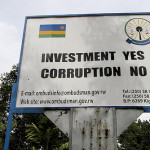
In most African countries there is only one way to assured wealth: politics. When you are a politician you have access to a good salary and most importantly public funds. Public funds can be skimmed to buy a Mercedes—the car of choice for wealthy Africans—a nice house and allow you to live a lifestyle out of reach to the majority of your constituents. A life in politics is less a calling to public service, but a get rich quick formula. It is seen as a job and a job with lots of perks.
In Africa politics are often referred to as “politics of the belly,” since corruption is articulated as “eating.” At first when I heard this, I didn’t understand why people didn’t just say corruption but having traveled and lived in a few African countries, I now see it as a reflection of culture and daily life. Culturally, most African languages and people don’t make reference to sensitive or taboo issues directly, preferring to use metaphors. I’ve yet to determine, if it is a result of years of political oppression, which continues in many places, or simply just because most African cultures and languages prefer to use less offensive words.
One thing I’m sure of though is that the use of the term “eating” to describe corruption is a reflection of the daily struggle to pay for food that many Africans face. Five hundred million people live on less than $2 a day in Africa, and of these 320 million live in extreme poverty on $1 or less a day. For those facing destitution, it is extremely rare to eat more than one meal a day. It is not uncommon to hear of rotating eating schedules with family members taking turns, with girls often receiving less, of course. Eating every other day, or every few days is a reality for many.
As much as I disagree with the politics of the belly, I understand it. Corruption is ingrained in government starting with the head of state who usually embezzles millions during the course of his term. In Congo, the phenomenon was exacerbated during the dictatorship of Mobuto. He was an expert in stealing public funds, leaving his citizens to fend for themselves. To this day, many Congolese live by the mantra developed during Mobuto’s time: “debrouillez-vous.” In English, this more or less translates into “fend for yourself.” With this attitude it is not surprising the corruption is rife throughout the echelons of power. Contributing to the situation is the almost complete lack of a vibrant private sector. In most African countries the private sector is very small or dominated by foreign companies which pay meager salaries to local workers, invest very little locally and send their capital back to their Asian, European or North American based headquarters. In this climate it is difficult to earn a decent salary, unless you happen to be one of the lucky few who works with resources as a buyer or trader, likely a job bordering on illegal. So what else is there? Government.
I often hear people saying Africa needs more schools, more skills-training for its young people, and that isn’t wrong, but what Africa really needs is paying jobs! Until people are paid regularly and decently in the public sector and the private sector takes off, it won’t surprise me to see so many people vying to enter politics and those already in it “eating” much more than everyone else.


Comments are closed.

Great opening line. I agree with your conclusion about decent and regular paying jobs, maybe a possible way to move towards this would be preventing the multi-nationals to take all of their profits out of country. To require that they reinvest a percentage of these profits into the local economies, and if this is in place maybe increasing the percentage or alerting advocacy groups if they are in violation of these requirements.