Congratulations SFCG: Sierra Leone!
Search’s Talking Drum Studio in Sierra Leone won two awards in the 7th Annual National Media Awards organized by the Independent Media Commission on Friday, May 24th. The Independent Media Commission is the regulatory body mandated to ensure ethics of good journalism are maintained and practiced by media houses. It honors deserving media practitioners who contribute meaningfully to society and follow the ethics of the profession.
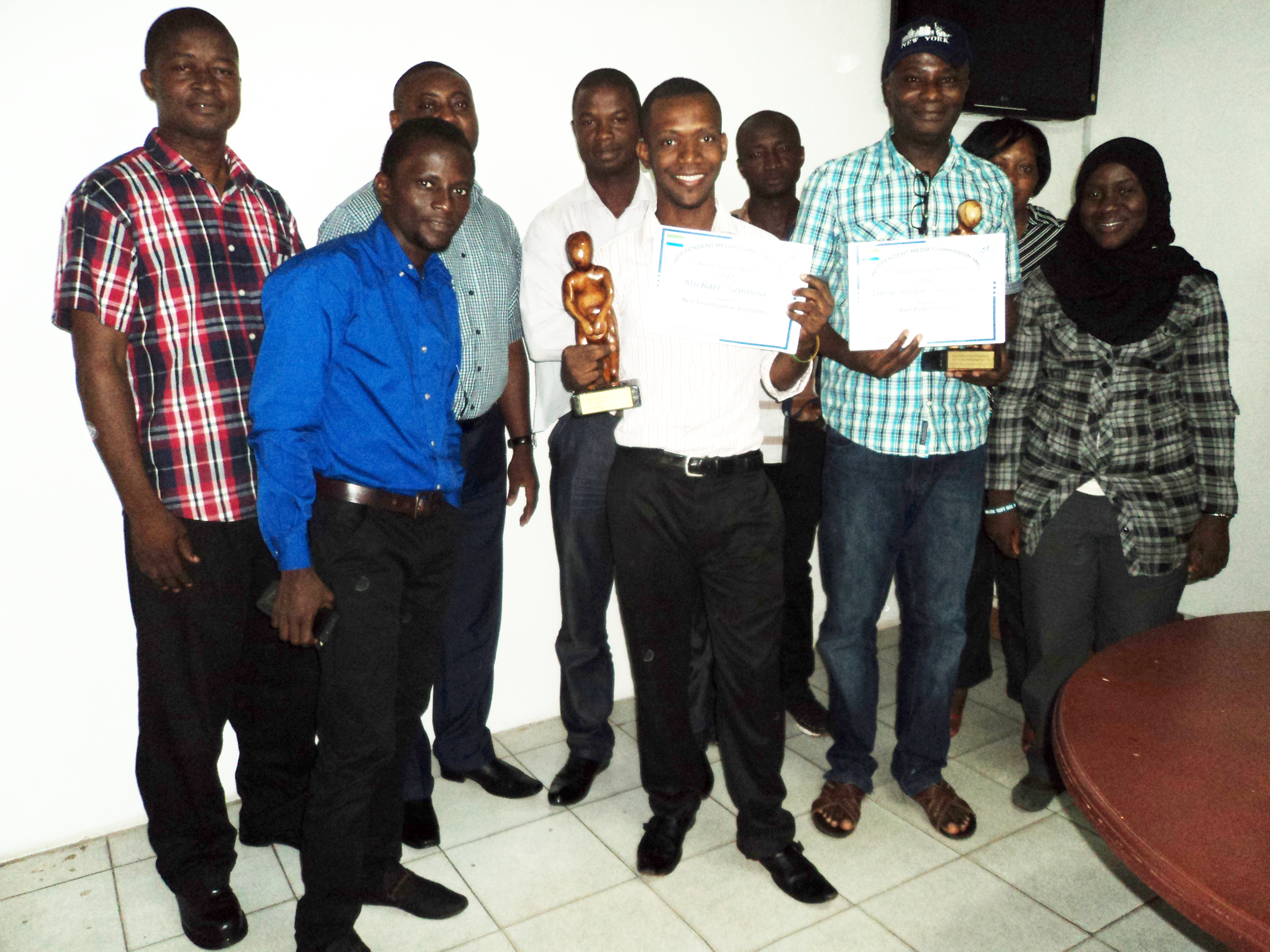
The first award went to Search’s Borderline program for Best Investigative Story, submitted by Producer Michael Sambola. The second award was Best Radio Drama for Search’s radio soap opera Atunda Ayenda, submitted by Emrys Savage, SFCG’s drama and video coordinator.
Atunda Ayenda (Lost and Found), Search’s flagship radio soap opera, is popular all over Sierra Leone, broadcasting Monday through Friday on 27 radio stations across the country. It
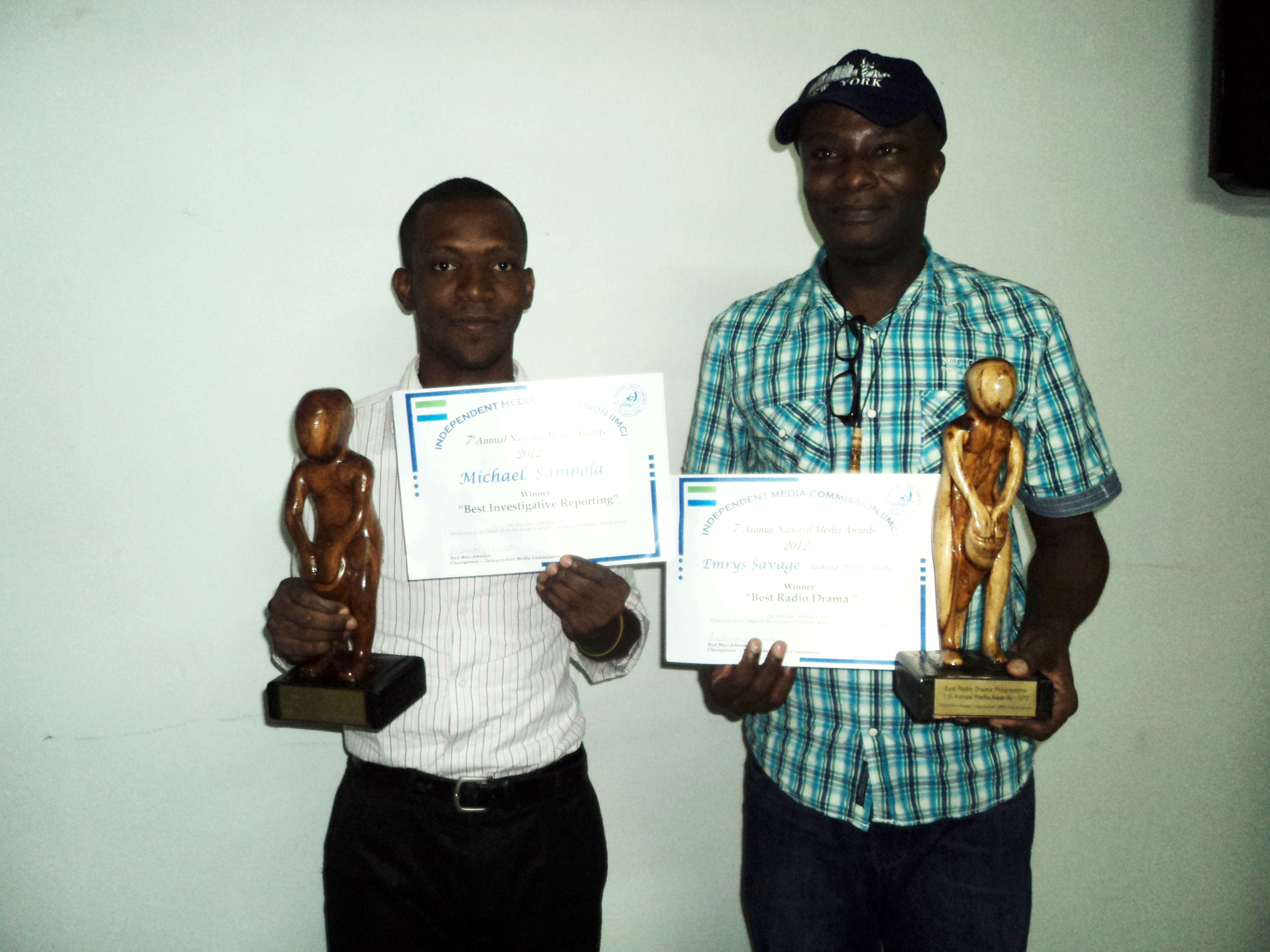
Michael Sambola (Left) and Emrys Savage (Right)
follows the story of ex-combatants who went through the process of disarmament and demobilization and now reintegration and carries contemporary issues of the day around governance, accountable leadership, gender, health and more. Atunda Ayenda will hit its three thousandth episode sometime this year.
Borderline raises issues around youth employment, inclusion and participation in governance and decision-making.
As Ambrose James the country director says,
“This is the reward for hard work, passion and commitment to what we do as we strive to help build an inclusive society where communities can coexist for sustainable peace and development”.
To learn more about our programs in Sierra Leone, click here.
When opportunity knocks: A young girl’s rise to Vice Mayor
Aichata Dahabaye
In every nook and cranny of the globe there are individuals who are full of untapped potential. They are intelligent and inspired, longing to make a difference, but needing assistance to truly make their presence known. Aichata Maman Dahabaye was one of those individuals.
We first met Aichata in late 2012 when she participated in Search’s Youth Leadership Program in Niger. Aichata’s involvement in youth activities and engagement in her community, as a member of the municipal council, made her an ideal candidate for the workshop.
During the training, Aichata and the other participants learned about the principles of positive leadership, conflict management, youth mobilization, and community engagement. Following the program, Aichata employed her new skills to improve her activism and further develop her community initiatives.
Aichata’s hard work and dedication paid off during the most recent elections when she was chosen by her peers to be N’Guimi’s first female Vice Mayor! She earned this distinction despite being the youngest member on the municipal council.
Aichata was made for this leadership position and clearly her accomplishments are a testament to her talent and determination. However, Aichata recognizes her participation in our Youth Leadership Program as a turning point in her career. In her own words:
“The training I received in Leadership helped me to strengthen my skills as an actor in the community… The skills I learned in active listening and conflict management helped me greatly in this role. Although I am the youngest member of the local government, I find that the people respect me a lot.”
Aichata is no longer filled with untapped potential; instead, she has realized her power and is utilizing it to improve her community. She had possessed the qualities of a great leader, but needed to learn how to refine those skills and use them effectively. Search simply gave Aichata the tools she needed to achieve greatness.
There are others like Aichata out there, youths who have powerful ideas and just need a bit of support to make their voices heard. So, we’re gearing up for the next program and the search continues….
Pakistani pioneer blossoms from wallflower to starlet for change
“I wanted to excel for myself and my community,” says Rukkaya Hashmi of the Balochistan National Party. She had always believed that she had what it took to lead her people, but 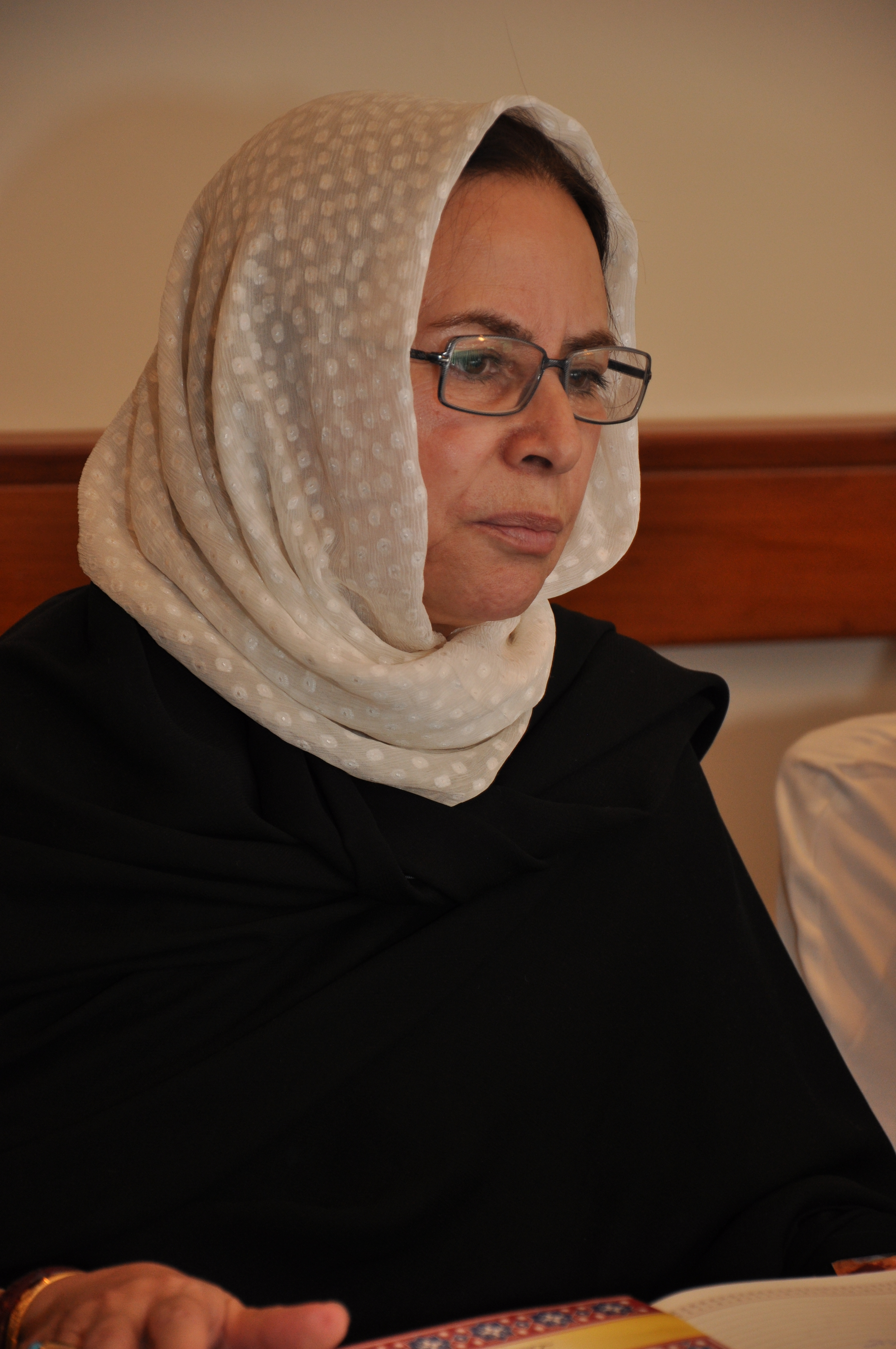 Rukkaya found she was never really heard or seriously noticed by her party’s leadership. “It was during this time that I started to question my own capabilities,” remembers Rukkaya. “The problem surfaced in political meetings and also in my efforts to reach the media.”
In reality, there is no reason why Dr. Hashmi should ever question her abilities. She is a powerhouse, the first to accomplish many things in Pakistan.
- The first female doctor in the Hazara region.
- The first to serve in uniform as army captain in the medical corps.
- The first woman Member of the Provincial Assembly from her community.
- The first to be appointed minister of the Assembly.
- In the coming elections, she’s the only woman candidate contesting from a general seat in Balochistan (one of Pakistan’s four administrative provinces).
However, this accomplished woman felt like a wallflower in her own party and with the media.
Then Search invited Rukkaya to participate in a training on Effective Media Messaging, held as part of its “Strengthening Women Parliamentarians of Pakistan for Effective Government” project. She was encouraged by what she learned and participated in further training sessions. She courageously ventured out to test her new found skills on a few media persons, but her first attempts flopped. “I was convinced that it was never going to happen, and I almost gave up. But one message of the training was to carry on and be persistent in my messaging,” she recalls.
So she forged on.
It was a good thing she did because her training ended up changing her life and her career, Rukkaya explains:
“After the massacre in Hazara Town of Quetta, where hundreds of people were martyred in bomb blasts, I was shaken. I desperately wanted to speak up for my people and present solutions to both media and my party leadership. After the massacre, President Asif Ali Zardari visited Quetta and I managed to assemble a delegation of like-minded political leaders to meet with the president on his visit. We were surrounded by the media. They were continuously questioning. The person heading the delegation tried to answer. However, the media did not seem to be satisfied with those answers. In that moment, all the techniques I had learnt in Effective Media Messaging Training Workshop came into my mind. My courage emerged, and I started talking. Suddenly I was getting heard. I was the most prominent person in the crowd. That was shocking even for me but then I handled the whole situation very technically, applying all the tactics I was taught that could bridge the gap between media and a politician. The next thing I knew, I was leading my delegation and discussing the whole situation with the President of Pakistan!”
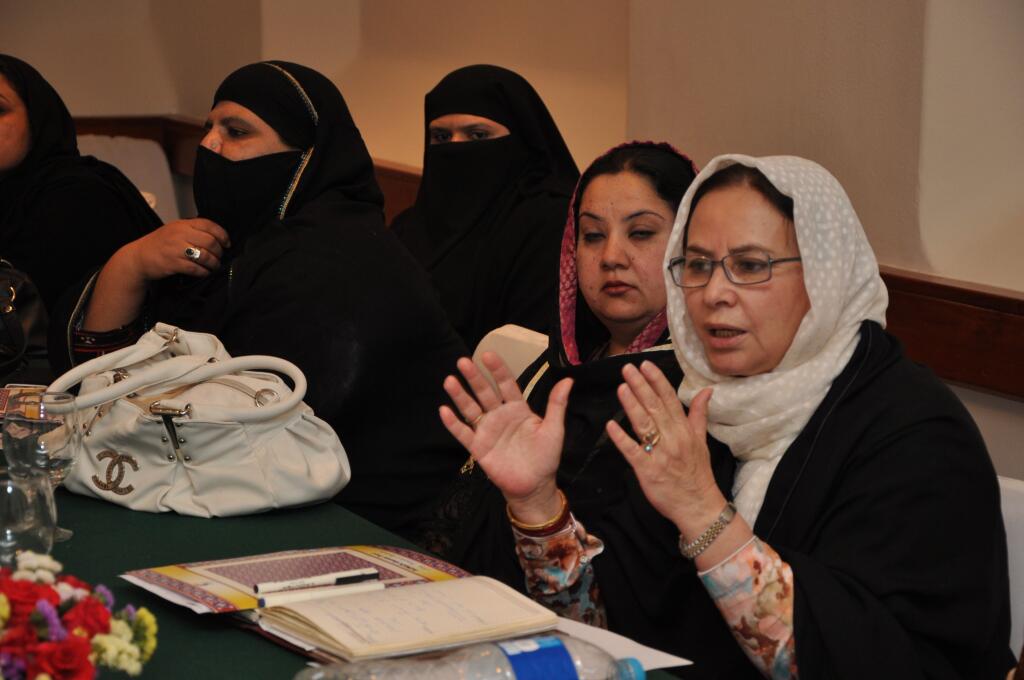
Dr. Hashmi speaking during SFCG: Pakistan’s ‘Second Women’s Leadership Forum’.
Rukkaya is now a prominent and leading politician in Balochistan. Her efforts and services are always covered by the media. “In fact, now I feel more comfortable to communicate with the media and they feel the same,” she says. Read this article that was published just this last week by the Pakistani media featuring Dr. Hashmi, “Courage in Dangerous Times”.
Happy World Press Freedom Day!
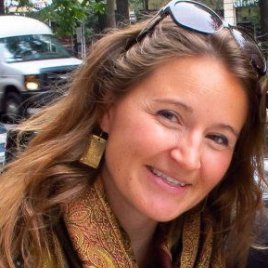
Juliette Schmidt, Director of Partners in Humanity and Editor-in-Chief of CGNews
From Sri Lanka to Rwanda, from radio to television, from Golden Children News to media for women, Search’s journalism work spans the globe. We wanted to hear from our Editor-in-Chief of Common Ground News Service, Juliette Schmidt, to see why journalism is so important to peacebuilding. The Common Ground News Service addresses key issues affecting Muslim-Western relations and race relations in the United States. Juliette manages an international team and has experience designing and leading programming and training workshops in the Middle East, Southeast Asia and South Asia. Here is her thoughts:
Why is freedom of the press important?
Schmidt: A free press can be a very effective tool in resolving conflict. Media plays an important role not only in shaping public opinion, but in determining which events or which stories become news, and thus part of the national discourse. The freer the media space is, the greater the diversity among media producers, making for a more comprehensive the picture of what’s happening. Also, free press promotes a healthy level of checks and balances to test one-sided perspectives. It creates a sort of dialogue between individuals and outlets that enables people to see commonalities and the “humanness” or the dignity of the “other”.
What role does journalism play in conflict and peacebuilding?
Schmidt: Professional and ethical journalism can go a long way to promoting a culture where diverse perspectives are 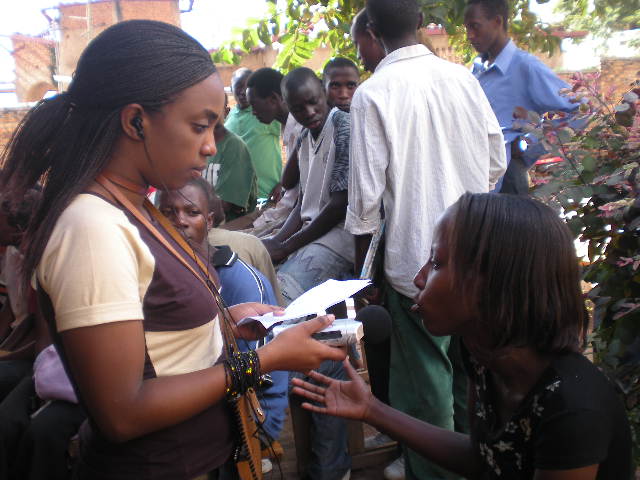 heard and rumors are either proven or dispelled. Dispelling a myth or rumor can be a contributor to resolving conflict.
At Search for Common Ground, and particularly in the Partners in Humanity program for Muslim-Western understanding, we have had the opportunity to engage with journalists around the world. From South/Southeast Asia to the US, from Europe to the MENA region, we connect with them through workshops, trainings and as writers for the Common Ground News Service. At the end of the day reporters are individuals often trying to produce the best journalism they can. They struggle with questions about what to cover and how to cover conflict when they themselves may come from a community that is affected by it.
There is power in media, and thus responsibility. Just as media can inflame tensions, it can also play a role in bridging communities.
What are some common ethical grievances you have encountered while training journalists in a conflict zone?
Schmidt: I think we often think of journalists as a monolithic group of tough, hardened individuals. In fact, in many cases journalists find themselves covering violent conflicts in their communities for the first time and feel unprepared. It becomes difficult when you feel your family and friends have been unjustly targeted and yet ethical journalism requires you to speak with and include the views of those whom you may see as a perpetrator of violence. It takes incredible courage and the ability to recognize the emotional triggers in oneself, in order to report professionally and constructively, in such a context.
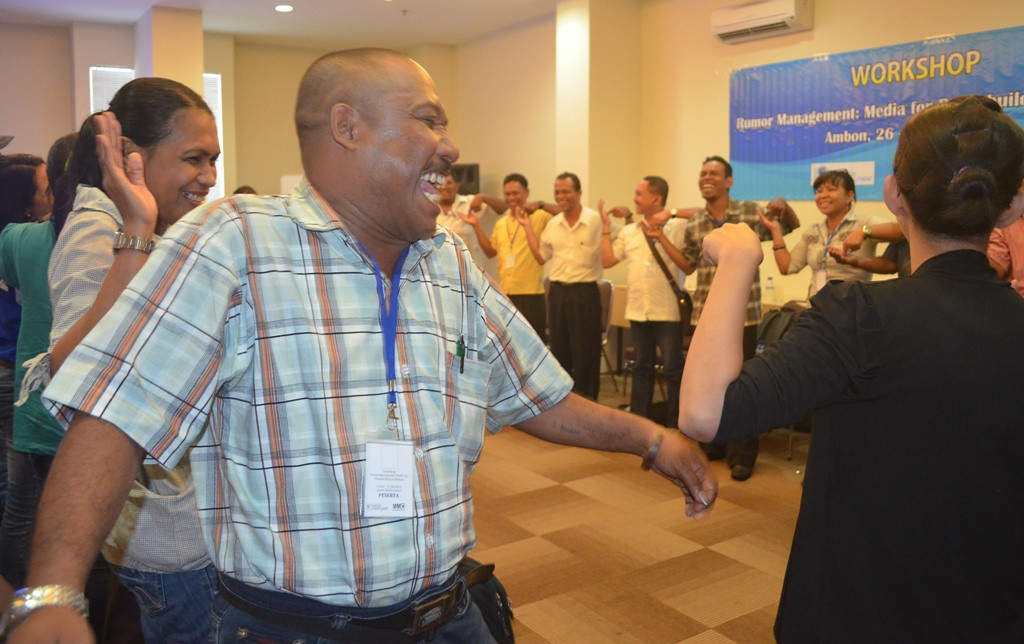
Journalism workshop in Indonesia
What is the common ground approach to Journalism training? Does that mean they should only report stuff that promotes peace?
Schmidt: Common Ground Media differs from “peace media” in that it does not seek to advocate for a particular solution. Instead it aims to rectify misconceptions, clarify issues, highlight commonalities and underscore the positives. It is rooted in the idea that instead of focusing on debate and differences, journalists can use a dialogue-style, which looks at the commonalities that humanizes the other and provides context around the differences. Such characteristics are based in professional and ethical journalism.
As mentioned above, the Common Ground News Service addresses key issues affecting Muslim-Western relations and race relations in the United States. What impact is CG News having? And what do you hope to achieve through it?
Schmidt: How many times found yourself describing to a friend an article or a story that expanded the way you think about the world. This is what we hope to achieve with the Common Ground New Service: to touch readers and provide a fuller story of what is taking place in the broad realm of Muslim-Western understanding by complementing existing media stories with context, back-stories, unheard voices and constructive recommendations for ending violent conflict.
In addition to our over 30,000 subscribers who receive the edition weekly in English, French, Arabic, Indonesian or Urdu, perhaps our greatest value is in reaching media audiences in the outlets that they already read. Each article is reprinted in diverse traditional and online media outlets an average of 30 times each reaching hundreds of thousands of readers.
Common Ground News Service contributors – who make up a growing network of over 2000 writers – frequently tell us that  they have been approached by other media outlets, conference organizers, partners, or even governments, to share more and develop on the topics they write about. Injecting these unique and diverse views into a larger discussion is also a key result of the news service.
And readers have gotten in touch to share how articles have touched them. These anecdotes count among our measures of success.
- “It is work like this that helps dispel the wrong notion we have about the Muslim world.” – CGNews reader from the United States
- “The editorial I wrote has opened doors and impacted others – I just returned from presenting the editorial at a peace conference in Italy. The opportunity you enabled has opened my eyes and impacted me. I am developing the idea I wrote about and looking to apply it.” – CGNews contributor
- “Because of [everyone who contributed to releasing my article] I received many useful comments and encouragement. Even the Ministry of Political Development asked to meet with me to discuss the content of the article.” – CGNews contributor
- “Reverend Lavender’s article has motivated me to ‘do something’ in response to recent depressing events instead of just feeling helpless and in shock. For one thing, I WILL forward and share this article and, hopefully, it will show people in this part of the world that not all Westerners are ignorant and unreasonable.” – CGNews English edition reader
- “No matter what I hear from our general media, there are a lot of people in this world who want to make it a better place for everyone.” – CGNews reader
“It is said that in the longer run, the pen is mightier than the sword … and it is truly manifested in these times where fear and hate are the result of improper information! In the present time, the whole world is polarised between two extremities. Firstly, one of fear and hatred… secondly, the focus on economic sustainability and ethics. It is at these times that your article showed a ray of hope.” – Qatari reader - “I used to think that Westerners and Muslims hate each other deeply, but this misconception was due to my being influenced by some extremist opinions and some conservative readings from other sides. [CGNews] has helped dissipate these ideas.” – CGNews Arabic edition reader from Yemen
Former militant turned peacebuilder brings ‘comic’ relief to Congo

Out of the deadliest trenches rise some of the most brilliant peace-builders. During the ‘90s, violence plagued the Kivu region in the Democratic Republic of Congo (DRC), pulling Joseph Muhaya into the conflict. After hearing about Search’s work, he started looking for non-violent ways to end conflict. He is now the author of the wildly popular comic books “Mopila” and the widely known character Captain January. A militia fighter turned creative peace-builder. Here is Joseph’s story:
I have lived through troubling times, through many conflicts since I was born. Son of a tribal chief, I was born at a time when colonial leaders would force rebellious tribal chiefs into exile. When I was two years old, my grandfather, who was the Chief of Buloho in Bunyakiri (South Kivu), suffered this fate. He was sent into exile in Chambucha in Walikale (North Kivu). When I was not yet 11, my family and a large part of our community were also exiled for nine months to a neighboring village. The colonial regime put in place a chief from Kabare in South Kivu, a source of conflict in my region to this very day.
Since our independence in 1960, our country has never seen the end of wars and secession movements. From 1974 to 1994, I was a teacher, happily married and father to 8 children. When large-scale fighting broke out again in 1996, I fled to the forest and joined a local Mai-Mai militia movement. While we were still fighting in the forest, I heard of “Centre Lokolé” (the name of SFCG in the DRC). They were broadcasting radio programs on what was happening at Sun City, where an agreement was signed that ended the Second Congo War. I arrived in Bukavu in 2006, where I heard that Centre Lokolé was looking for writers. I had been a writer from a young age, and I even wrote two novels while fighting in the forest. I was hired.
I have worked for SFCG for many years now, and they have given me the opportunity to contribute to peace-building in my country and to develop my own outlook. I pour my heart and soul into covering the war because so much of my life was spent in the shadow of war and conflict. I write radio soap operas like Jirani ni Ndugu (My neighbor is my brother) and Lobi Mokolo ya Sika (Tomorrow is a New Day), and of course, comic books. My mission is to plead with my brothers and sisters, via my work, to put down the war ax and come together at the same table to build a more peaceful future. I hope that all of those who read or listen to my work feel touched and are ready to make a change, to put down weapons of war and pick up the tools of peace and development.

Search has already distributed over 500,000 comic books, and we are flooded with requests for more. The name of his corrupt character Captain January is so widely known that it has entered the military vernacular, with soldiers using it as a way to warn colleagues who harass civilians. To learn more about the comic books, click here.
Do you have any ideas to creatively end violent conflict? We’d love to hear them in the comments below!
By Stephanie Fagan
Since a young age, I greatly admired broadcast journalist Christiane Amanpour for her honest news coverage and courage to address women’s issues in various parts of the world. (It also doesn’t hurt that she began her career at my local news station in Rhode Island.) Either way, I grew up with Amanpour as a beacon of truth. She inspired me to think deeper, carefully analyze current events, and respectfully question everything I am told.
 With Amanpour and her female colleagues as role models, I grew up knowing that I had a voice in my community. However, millions of young women around the world don’t have such female role models. That is why, on March 8th, Search launched its “Media: A Voice for All” initiative in Rwanda, Burundi, and the Democratic Republic of Congo. The project will extend to the Central African Republic and the Republic of Congo in the near future.
The program has two objectives:
1. Increase the number of female journalists in the Great Lakes region of Africa
2. Improve gender-sensitivity in media coverage, especially on women’s issues
To reach these goals, Search is partnering with local women’s media associations in each country. The program will provide training sessions, capacity building instruction, innovation grants, sensitization activities, and networking development.
To celebrate the commencement of this two-year program, Search hosted launch parties in Rwanda, the DRC, and Burundi. Below are reactions from the local women journalists:
Rwanda
-
Jane Uwimana, reporter at Radio 10/Kigali: “Since we will have enough women in [the] media sector, we will have a great number of people writing, reporting on gender issues and advocating for women.”
-
Faith Mbabazi, president of the partner women’s media association ARFEM: “We will approach young girls in the school of journalism and tell them, ‘Hey! Look, journalism is the best thing you can ever opt for, and there is nothing that you would like success from other than writing a story that will change someone’s life.’”
Democratic Republic of Congo
-
“I am extremely happy about the launch of this project, and especially of the small grants for the production of gender-sensitive radio programming. This competition for small grants, open to Congolese radio journalists, shows that SFCG understands that local journalists are capable of producing radio magazine to high quality standards.”
-
“This project is great. It will enable Congolese women journalists to better understand and learn from the reality of other women journalists in the Great Lakes region, and how they address gender issues in their countries.”
Burundi
-
“Improving women’s image in the media must go through an improvement of women’s image in society, and requires from the media that they give a voice to women and encourage them to speak up, because they have a talent and intelligence that [the] media do not exploit.”
Excitement surrounds the “Media: A Voice for All” project. This program will directly impact the lives of millions of women in the Great Lakes region. The media harnesses immense responsibility.  Journalists not only relay the news, they also frame it for the public. As a result, supporting female journalists and increasing gender-sensitive reporting can positively affect many facets of society. It can completely transform the status of women as they become vessels of knowledge and respected figures in the community.
The actions of today shape the dreams of tomorrow. If more women become prominent journalists in the Great Lakes region of Africa, it will inspire younger generations of girls to do the same. At the end of the day, every young woman deserves her own Amanpour. We are working to make that a reality.
______________________________
Stephanie Fagan is a graduating senior at The George Washington University’s Elliott School of International Affairs, where she studies international affairs with a concentration in contemporary cultures and societies. She believes that understanding nuanced cultural differences is essential to the peace building process. Stephanie is the new media intern at Search for Common Ground.