Removing Child Soldiers’ Scarlet Letter: ‘Body Mapping’ and ‘PhotoVoice’ help reintegration
By Julia Boccagno
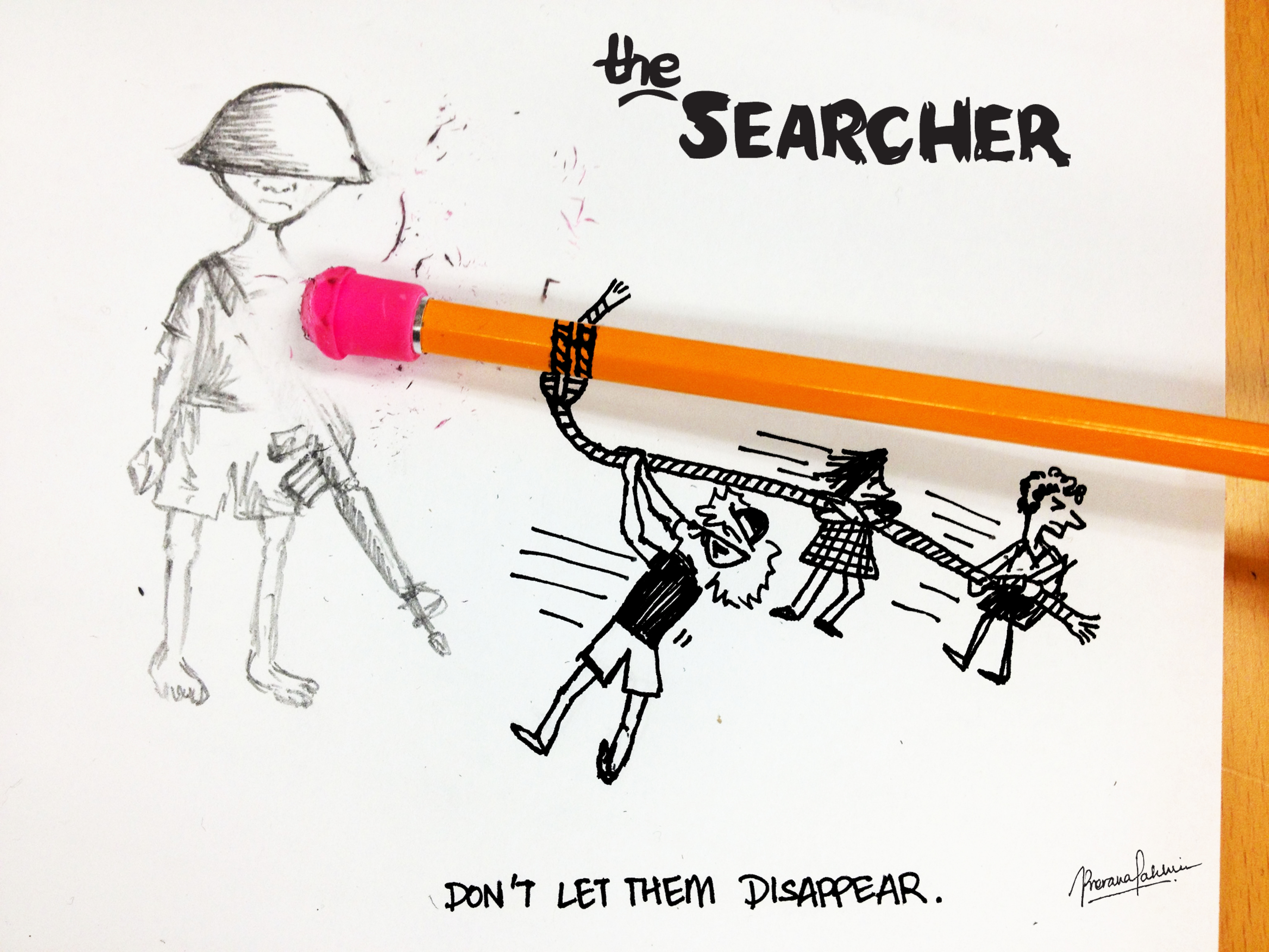
“You are nothing.”
“You don’t deserve life.”
These are the words former child soldiers live with daily in the Democratic Republic of Congo.
Since the Second Congo War ended, over 31,000 underage combatants have been released from non-state armed militia groups. Besides experiencing immense physical and psychological trauma, former child combatants return home to be treated with hostility and mistrust by community members–leading some to rejoin the military rather than face social isolation.
Using new revolutionary techniques, researchers of the Harvard Humanitarian Initiative (HHI) and of the Eastern Congo Initiative (ECI) partnered with six Congolese community groups to improve future reintegration programming for former underage combatants and at-risk teenagers. At our latest Washington Network on Children & Armed Conflict (WNCAC) forum, both organizations presented Innovative Participatory Research with Former Child Soldiers in Eastern Congo.
“You live in difficult conditions, have difficulties in eating. You have no job, you start envying people’s belongings,” explains a former male soldier from Uvira. “You remember that in military life, you were looting civilians, and you could have something to eat. Now, you regret the causes which pushed you to leave military life.”
In response to the situation, HHI and ECI decided to include the affected children into the research process. Using techniques known as “Body Mapping” and “PhotoVoice,” researchers not only gathered information for future reintegration methods, but were also able to give the former child soldiers a sense of independence and control for the first time.
During each Body Mapping session, a facilitator presented each participant with a large piece of paper with the outline of a person traced on each. Moderators then purposefully asked 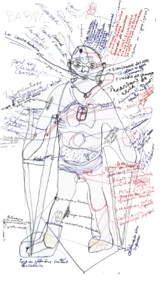 each former child soldier a series of open-ended questions to facilitate visual storytelling. One example of a question asked was, “What is the effect of being an underage combatant on a child’s head?” Participants would then literally draw out an answer on the Body Map. At the conclusion of each session, the Body Map displayed a “map” of seen and unseen effects.
The results of this research method illuminated the psychological and physical trauma that former combatants encountered. One former female child soldier described her Body Map:
“Her eyes have seen bad things: people dying and being raped. Her nose has smelled the dead people and her ears have heard the bullets crackle and the large missiles of war. Her mouth has eaten bad food, but does not talk.”
In addition to Body Mapping, HHI and ECI collected data using PhotoVoice, a method that visually represents the emotional, physical and psychological effects of a particular event. Participants were given a camera and asked to chronicle their own story with whatever image they feel best captured their experiences. Researchers were astonished at the depth of reflection and symbolism expressed through the photos, allowing them to learn about a child’s life before, during, and after being a soldier.
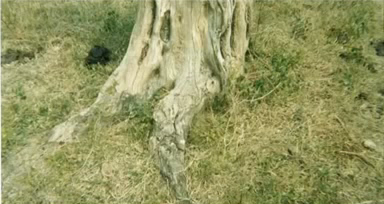
PhotoVoice. A child soldier’s explanation: Similar to this tree, former child soldiers are left without support, abandoned by their communities and in the process of disappearing.
After both the Body Mapping and PhotoVoice sessions, the researchers created a “Mobile Museum” that traveled to various schools and churches throughout Congolese communities. The public display of the raw and hidden struggles of child soldiers through the Body Maps and PhotoVoice images generated a sense of solidarity. Former child soldiers realized they were not alone in their challenges; while community members better understood and empathized with the complex hardships of former child combatants.
A community leader from Goma expressed that progress is already in the works:
“When a child goes to military life here in Africa, it means you have lost him, because we consider military life as a place of hooligans… but when he comes back home, you treat him as a human being. He can be a man in the future.”
To view the full “Innovative Participatory Research with Former Child Soldiers in Eastern Congo” presentation, click here.
____________________________
As a rising American University junior, Julia Boccagno majors in Broadcast Journalism and double-minors in International Studies and Italian with the hopes of becoming a future foreign correspondent. She firmly believes that objective news reporting is a vital tool within the peace and conflict resolution conversation. She is currently the New Media Intern at Search for Common Ground.
By Jessica Murrey
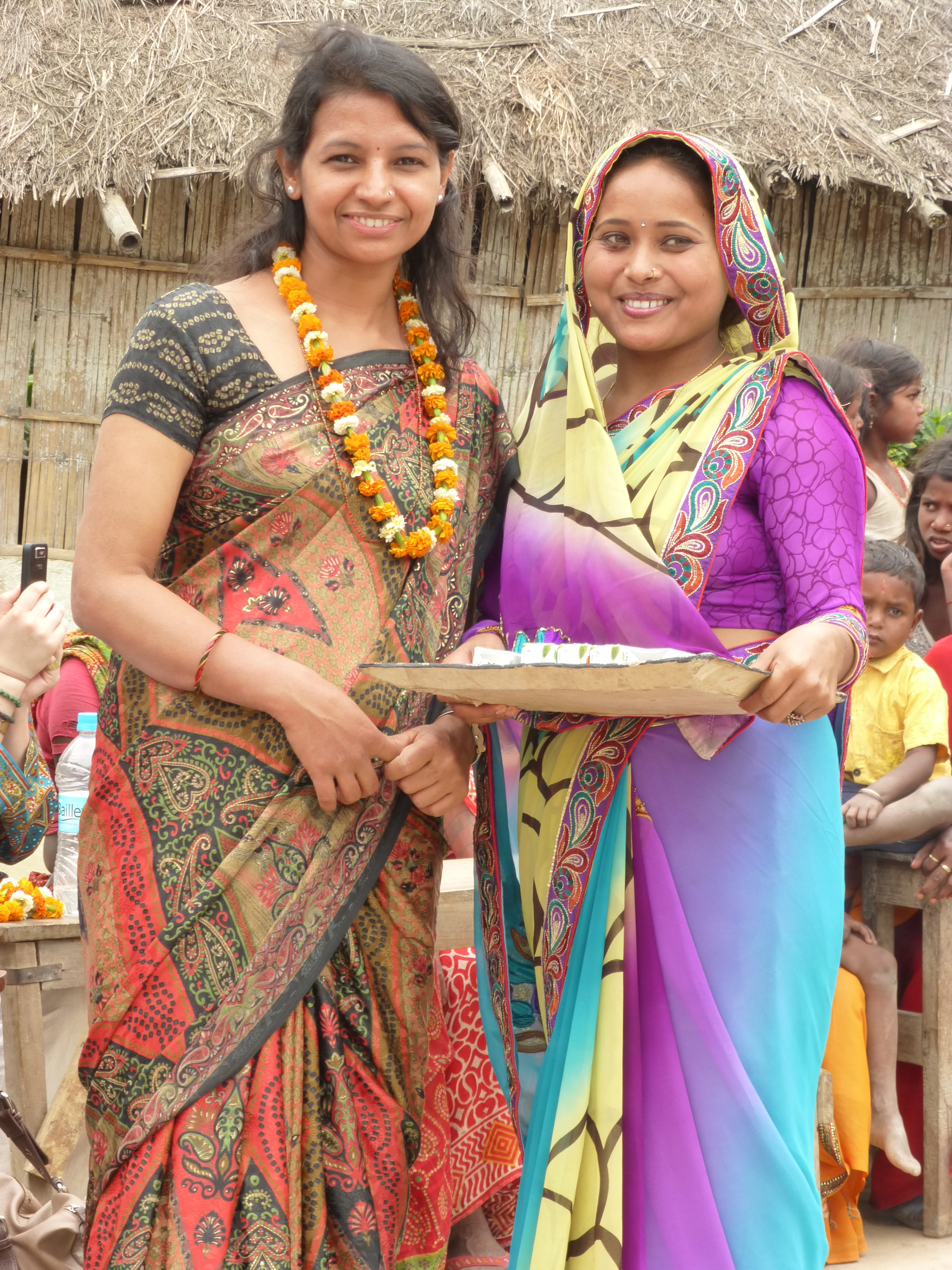
Meena with a participant in a peacebuilding program.
It was eight years ago.
Meena was making dinner when she heard a reporter announce horrific news on the TV. There was another massacre in a nearby village.
Nepal was in a state of emergency. Killing and violence between ethnic groups occurred daily, making Meena’s job a grim one. She worked as a human rights defender, tasked with surveying the damage. She tried to prepare herself for what she’d find there tomorrow, unaware that it would change the course of her life forever.
That next morning, she set off for the village with her colleagues. She was assigned to survey and report on how the fighting affected the women in the village. As they got closer to the village, she could see black smoke reaching toward the sky.
“When I got to the village there was a very bad smell, just a terrible odor, and complete silence. The only noise was children playing with the leftover bullet shells in the street,” said Meena.
One of Meena’s duties was to count the number of dead. A man led her into a large room. The bodies of the deceased were piled high. All Meena could see was the color red. She struggle to separate and count the bodies. Nausea threatened to overcome Meena. So she stepped outside to get a breath of fresh air.
There was sadness all around. A group of women mourned their children. Men quietly worked through the rubble, picking up the fragments of their lives.
Suddenly the somber stillness was interrupted by angry shouts. “This is all you fault! You’re the reason lost my son. You’re the reason I lost my house. You are cursed,” they yelled.
Meena walked towards the shouting to see who they were yelling at. There stood a woman standing with a baby in her arms. She said nothing. Her head hung low as she shuffled past her angry neighbors.
Meena followed her into the woman’s charred house. She looked like she was in her early 40’s, but she was actually only 28. Meena learned later that she had been forced to marry when she was 11, which was a common practice in this area.
Meena asked the woman why the villagers blamed her for the attack. The young mother had a hard time talking, but finally explained that just two hours before the attack her baby boy was born at home. They proudly announced it to all the villagers. It was only moments later the attacks followed. Due to local superstition, the villagers believed the baby brought with him bad fortunes on the village.
She then went on to explain the gruesome events of the attack. Her father-in-law was the first to answer the door. This was an ethnic battle, and he tried to explain that his family wasn’t part of the minority group they were hunting. They shot him down in front of the young woman. When woman’s husband tried to stop them, they shot him too and lit the house on fire.
The young woman broke down one of the mud walls and ran for her life, to a friend’s house. But in the chaos, she left her baby in the burning house.
Early the next morning there was a knock on the door. It was a woman– one of the fighters who had attacked the village. In her arms was the young mother’s baby. She handed the baby to the mother and turned to walk away. When she turned the mother saw the fighter’s back. It was crimson, riddled with bullet wounds.
She had run into the burning house when she heard the baby crying. She pulled the baby close to her chest and used her back to shield him from the bullets coming from the helicopters above. She protected him and kept him alive throughout the night, and once the fighting stopped, found the house where the baby’s mother was hiding.
She died shortly afterwards. She gave her life to save her enemy’s child.
Among all the wreckage and despair, Meena had found a glimmer of light, a glimmer of hope in this story. That even in the darkest times enemies could find within themselves the common humanity to save a child.
“I knew then that I no longer wanted count dead bodies as an activist. I wanted to build peace–to find and share hope,” explained Meena. “That’s why I came to work for Search for Common Ground.”
___________________________________
Jessica Murrey believes media is powerful tool in changing the world for the better. She studied journalism and international relations at the University of Nevada Las Vegas and worked in broadcast television, forming messages of awareness and prevention against domestic, drug and child abuse. She is currently the new media coordinator at SFCG and editor of the Common Ground Blog.
By Benjamin Médam
A few years ago, Aliou Sagna was one of the leaders of Bouyan Bouyan Style, a youth gang known for its violence in Kindia, Guinea. Aliou remembers:
“We were young, lost and hot headed… We were just a gang of young guys without any objectives in life. Violence was a way for us to make our voices heard.”
Today, Aliou proudly introduces himself as the Vice-President of Kindia’s most influential youth association, which kept the name Bouyan Bouyan Style, but now has a clear objective: acting as peacemakers through music in their community.
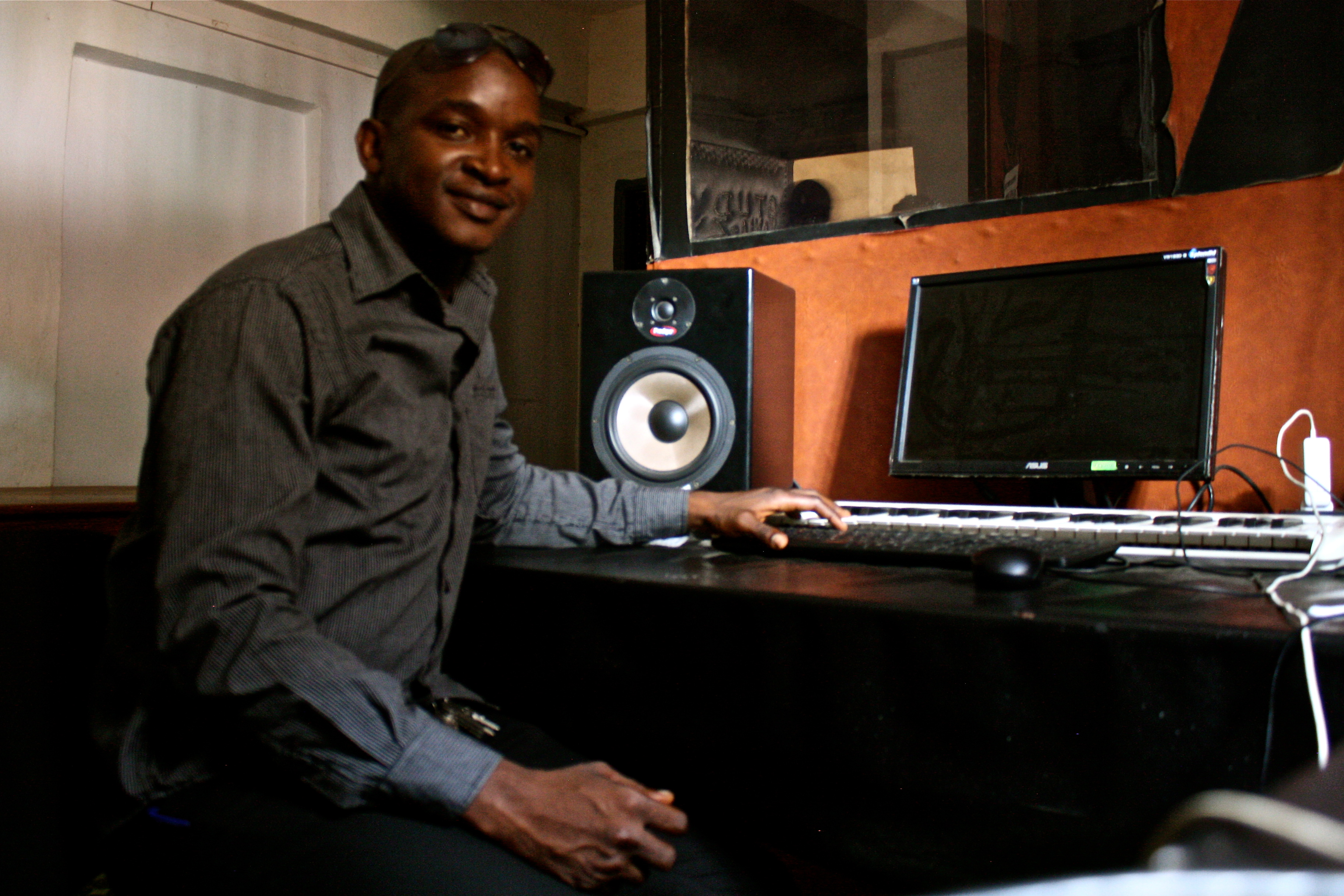
Aliou Sagna in KaniaZik FM radio station in Kindia, Guinea.
After participating in the USAID-funded project “Youth and Non-violence” implemented by Search for Common Ground (SFCG) in Kindia from September 2008 to March 2010, Saliou and his friends realized their full potential as influential non-violent transformational leaders.
“Youth and Non-violence” has been an integral part of SFCG’s effort to empower Guinea’s youth in a context of social crisis marked by significant political change and violent turmoil in Guinea. It came as the country was preparing its first democratic elections since its independence in 1958.
Thanks to trainings, capacity building in communication techniques, tailor-made radio programs and cultural festivals, Guinea’s urban youth gained awareness of their rights, civic responsibilities and non-violent conflict management techniques.
“After participating in the trainings, I realized the importance of finding an objective as a youth association by getting out of the streets and having a positive role in our community,” said a proud and smiling Aliou. “Our goal is to help foster a more peaceful and stable future for Kindia’s youth through music. Thanks to Search, we now have the tools to do so while still being as ‘boiling’ and dynamic as before in what we achieve.”
After organizing festivals to promote Kindia’s young artistic scene, members of Bouyan Bouyan Style decided to maximize the gains of their training by opening the first recording studio in Kindia. “This allowed us to keep our home-grown talents and role models local while spreading their messages of peace and social cohesion,” he explained.
But Bouyan Bouyan Style did not stop there. “Those messages of peace and social awareness needed to be heard by a wider public,” he concluded. So they opened the radio station Kaniazik FM to spread their music and message. The group also gives back to the community by training 15 unemployed youth in music production, radio management and media coverage.
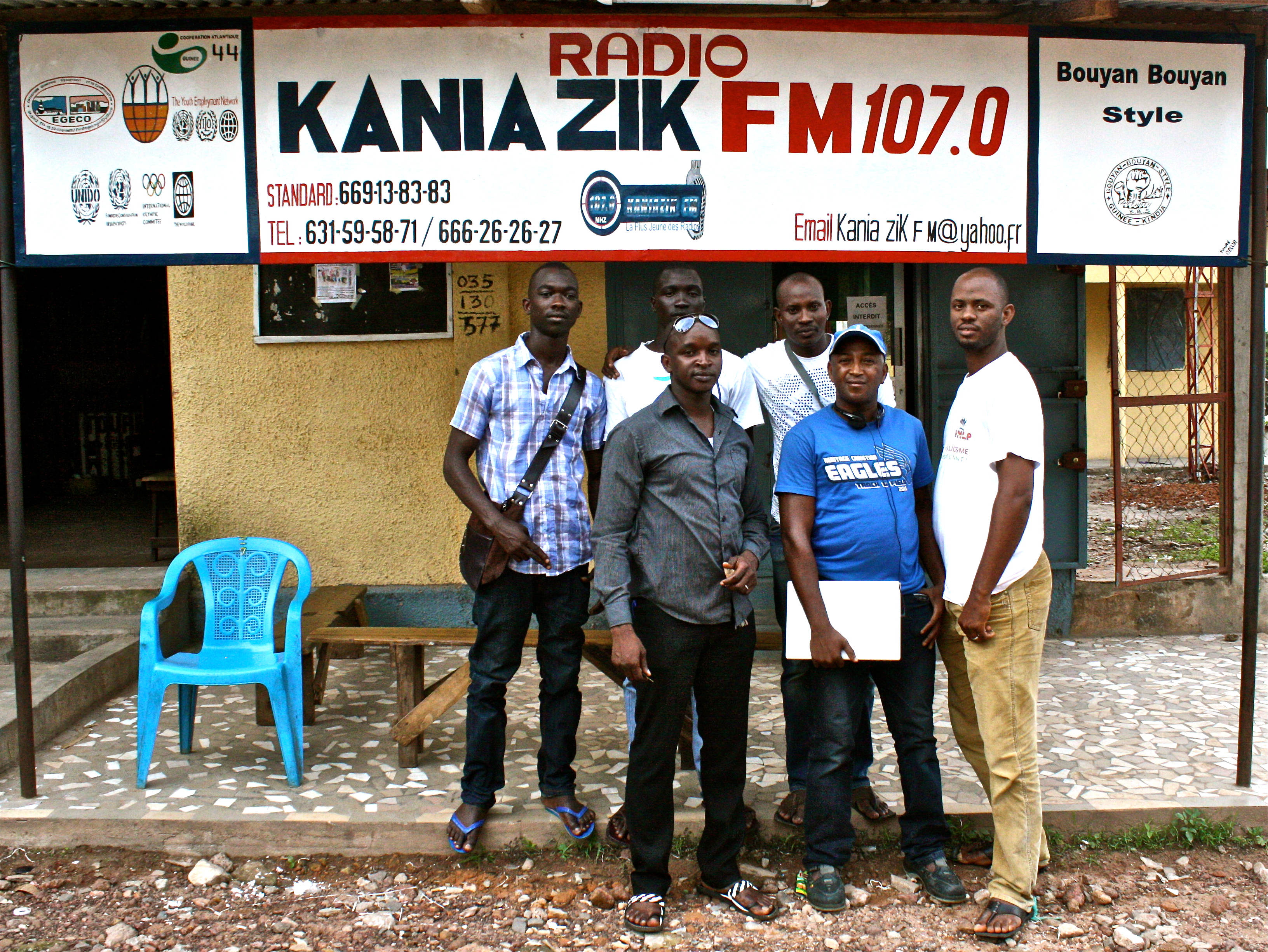
KaniaZik FM’s team proudly posing in front of their radio station in Kindia, Guinea.
Kaniazik FM has quickly become the most popular radio station among Kindia’s urban youth, and young leader Aliou Sagna could not be more proud.
Search for Common Ground continues to work with Kindia’s youth through the project, “On est ensemble” (We are together), to strengthen the capacity of key actors to facilitate reconciliation and social peace in Guinea.
___________________________
Originally from Montreal, Canada, Benjamin Médam holds a Masters degree in International Security and Conflict Resolution from Sciences Po Paris. A passionate traveller, Benjamin has lived and worked in New York, Buenos Aires and Paris. He is currently an intern at Search for Common Ground Guinea, working on Monitoring and Evaluation and managing a project on youth protection from violent protests in Conakry.
A phenomenon: Why some communities opt out of surrounding violence
By Sean Barrett
Why do certain “ordinary” communities, neither pacifists nor peace activists, abstain from the violent conflict that surrounds them?
How are they able to maintain neutrality while their neighbors respond with violence?
Where do these types of groups exist in the world?
These are the questions raised at this month’s Conflict Prevention and Resolution Forum (CPRF): “Opting Out” of Conflict. The speakers Marshall Wallace and Kristin Doughty, along with moderator SFCG VP Sandra Melone, discussed about how “ordinary people” can manage to avoid violent conflict while it completely surrounds them. The basis of this discussion was Opting Out of War, a book written by both Wallace and Doughty.
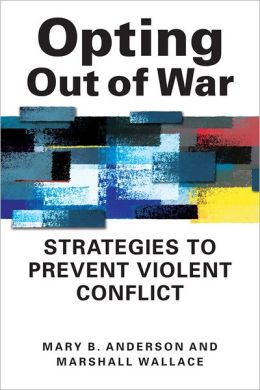 The book looked at communities in 13 countries– Afghanistan, Bosnia-Herzegovina, Burkina Faso, Colombia, Fiji, India, Kosovo, Mozambique, Nigeria, the Philippines, Rwanda, Sierra Leone, and Sri Lanka. Despite being surrounded by conflict, these communities managed to stay out of the fighting. An example given in the forum was the Muslim community in Rwanda during the Genocide of 1994 that somehow avoided all involvement.
Wallace pointed out three common traits among the communities that contributed to their “opting out”:
- an awareness of non-violent options
- a common sense of identity incompatible with the conflict
- the role of local community leaders
In other words, individuals within the communities realized that they were not backed in a corner– they had a choice to not fight. Their identity as a group did not require them to take up arms.
Additionally, one surprising trait was how those in leadership roles actively kept in contact with the fighting parties. One might think they would remain silent in the hope that their community’s absence would go unnoticed. This was not the case. Leaders of these communities engaged the fighters and managed to establish their community as “off limits” during times of conflict.
Still, the question remains: how can these communities serve as a model for future peacebuilding efforts? Most of the cases of “opting out” centered around smaller communities. How can the ability of removing oneself from violence be scaled up regionally and globally? This was one of many questions that audience members raised in regards to “opting out.”
Overall, the forum managed to inspire hope and constructive thought, which are two primary aims of the CPRF Forum. The attendees (and those who watched the webcast) hopefully left the forum with awareness of the possibility that ordinary communities can rise above violence and remain at peace.
__________
 Sean Barrett, a Communications and Special Projects Intern at Search For Common Ground, is a graduate student at American University where he studies International Peace and Conflict Resolution. His areas of interest include mediation, dialogue, and East Africa.
First regional network for media women in the Great Lakes of Africa
By Francesca Bessey
“Everyone, give yourself a hand!”
As Floride Ahitungiye’s congratulations echo through the conference room at the Star Hotel in Bujumbura, Burundi, those present cannot help but enthusiastically join in the applause.
I just witnessed the inception of the Great Lakes’ first network for women in media.
 It is July 10th, day two of the first Great Lakes Regional Conference on Women and Media, and Ahitungiye, the National Director for SFCG Burundi, has just led the room in the creation of the region’s first network for women in media.
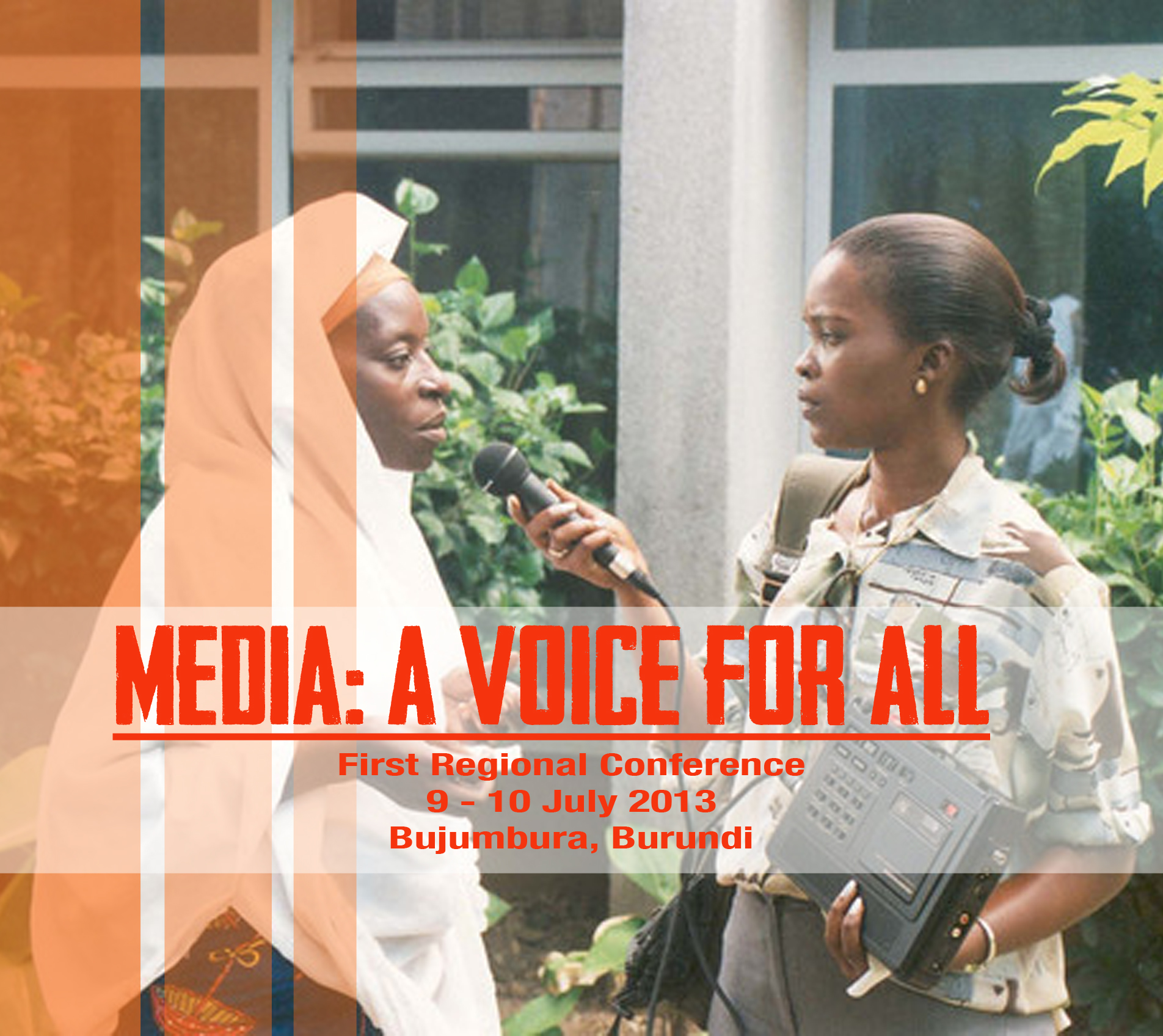
The conference, the first of four regional gatherings planned as part of Search’s ambitious project “Media: A Voice For All,” has brought together over 60 journalists, women leaders, and representatives from NGOs in Burundi, Rwanda, and the Democratic Republic of Congo to confront the challenges faced by women in the media sector of Africa’s Great Lakes Region.
The establishment of le Réseau des Femmes des Médias de la Région des Grands Lacs (the Great Lakes Women’s Media Network)is one of several initiatives within the project designed to strengthen connections between women media professionals throughout Burundi, Rwanda, and the DRC.
Additional initiatives include the creation of an SMS-based “early warning system” for area journalists, as well as regional exchanges, capacity building for women journalists, and the production of local gender sensitive radio programs. They will support the project’s overall goals:
- To increase diversity in the Great Lakes media sector, particularly through the reinforcement of women’s involvement in journalism.
- To increase the general public’s access to high-quality, gender-sensitive media programming.
I attended the conference as an observer and videographer. As someone who ‘s worked in journalism and women’s advocacy in my own country, I was struck by the similarities between the struggles of these women and those I’ve faced in my own work: cultural paradigms, stereotypes, lack of esteem…etc. At the same time, I was moved by the passion of those present—both men and women—to eliminate obstacles that I was fortunate enough not to experience, in particular a lack of access to higher education.
Along these lines, the conference was also highly successful in its capacity to bring together individuals from multiple backgrounds and experience 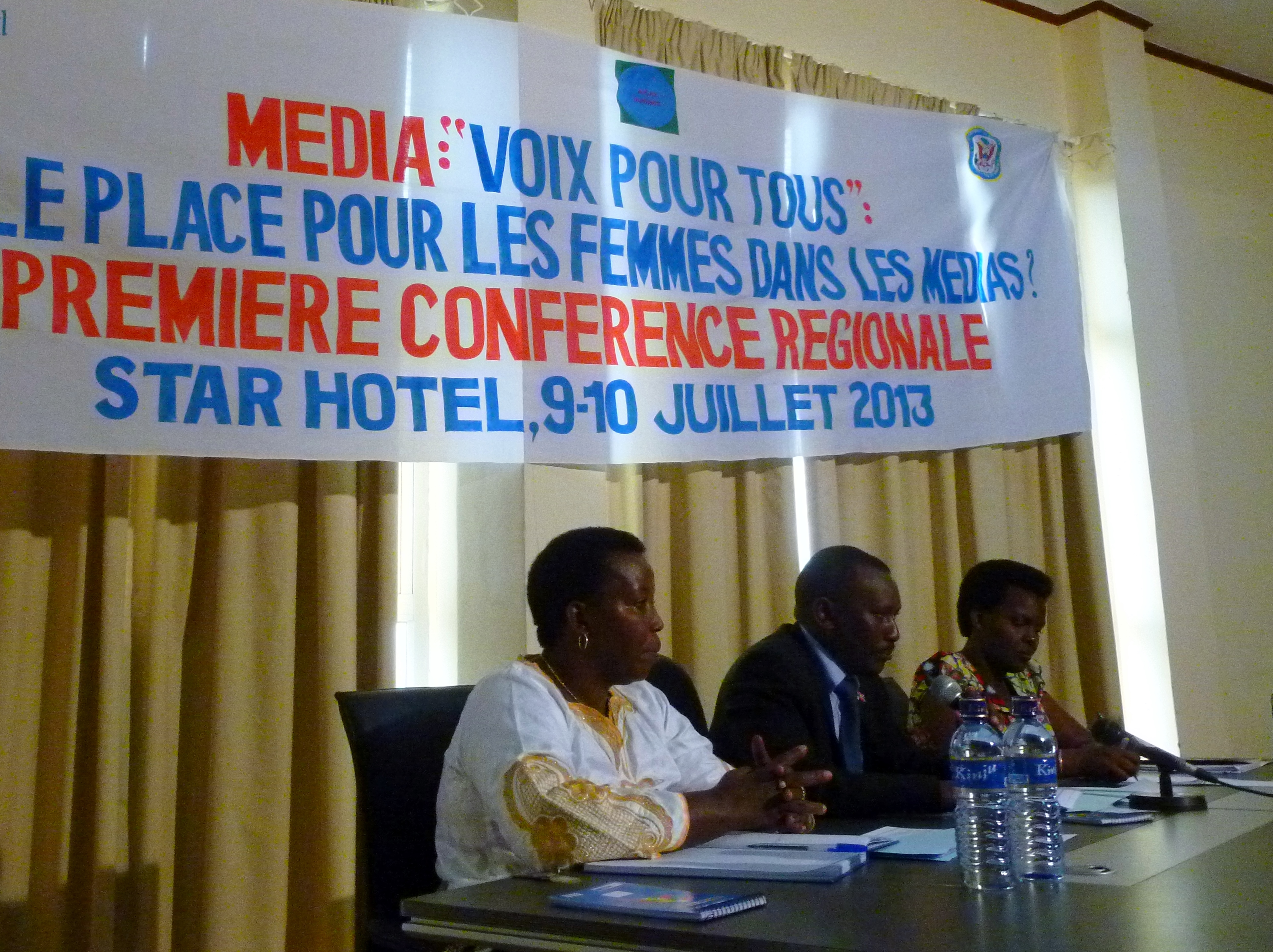 levels, offering some attendees their first ever opportunity to network outside of their own country or region. For one journalist from Rwanda, the chance to meet other women in her field and hear about their projects was an inspiration.
“There are others who have experienced more than me, who have been far as journalists, so I want to try more,” she said.
‘Collaborative inspiration’ is a common effort for change among people of different backgrounds, ethnicities, nationalities, genders and levels of expertise. This is what Search is striving for through “Media: A Voice For All”.
“There are challenges that perhaps we cannot overcome on our own, but that we can overcome with the united force of the three countries,” said hopeful Barakukuza of the Association of Women Journalists in Burundi at the close of the conference.
These challenges are great, but with such a force in place, it would seem that there is good news still to come.
List of distinguished guests:
- Frédéric François Sigejeje, the Permanent Secretary to the Burundian Minister for Telecommunications, Information, Communication and Relations with Parliament
- Representatives from each of the region’s three women’s media associations, whose partnership with SFCG will support the “Media: A Voice For All” project throughout its two-year duration
- Agathonique Barakukuza of the Association of Women Journalists in Burundi (AFJO)
- Emma Caudine Ntirenganya of the Women’s Media Association of Rwanda (ARFEM)
- Anne Mayimona Ngemba of the Congolese Women’s Media Union (UCOFEM) also gave presentations on gender and media in their respective countries
_________
Francesca Bessey is an international relations student at the University of Southern California and a current international intern at the SFCG office in Bujumbura, Burundi. Francesca has a passion for internet journalism and human rights, and has spent several years as a researcher and advocate on Africa’s Great Lakes Region.
By Jonas Holm Klange
“What is happening, oh my God! Why are you killing?!
Janet jumps in between the two groups of youth fighting fiercely, armed with wooden clubs and machetes. Bodies lay scattered on the ground, and injured youth scream in agony.
Luckily it’s not real, not this time.
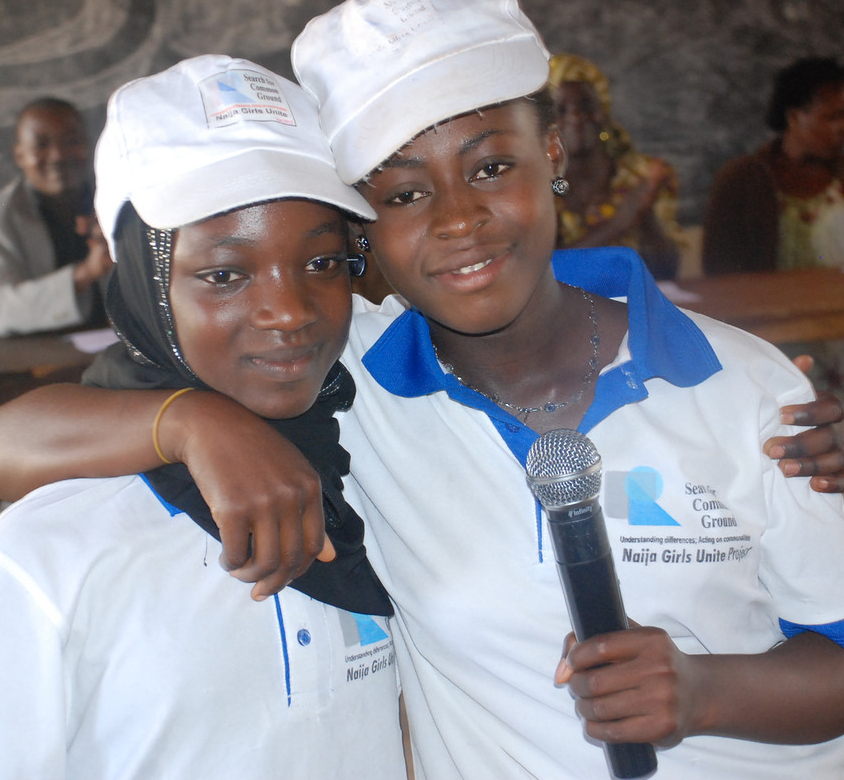
Fatima and Janet introducing the event for the audience
“We need peace in Nigeria! We need peace in Jos!” continues 15-year-old Janet. She then goes on to address the audience witnessing the play, entitled “Look before you leap.” The play addresses how rumor-spreading results in meaningless death in Jos, the violence-ridden capital of Nigeria’s Plateau State. The play, organized by Janet and her friend Fatima and performed by the drama club of Janet’s school, is an event for the entire Gwong Secondary School and their visitors.
The two girls, Janet, a Christian, and Fatima, a Muslim, met through Search for Common Ground Nigeria’s ‘Naija Girls Unite!’ During the camps, the girls trained as local peacebuilders and learned how to organize peace projects in their own communities. The idea was that the Naija Girls, with a little encouragement and support, can make a difference in their local communities and sow the seed for lasting peace where traditional leaders have struggled.
Jos has been haunted by inter-religious violence for more than a decade, claiming thousands of lives. Now fragile peace remains, but many fear that violence may flare up again. Formerly the tourist magnet, Jos is now divided into segregated communities with little interaction across religious divides – schools, clinics, playgrounds. Because Janet attends a government school, it has both Christian and Muslim students, but they tend to stick to themselves.
As it turned out, it didn’t take much for the 22 Naija Girls participating in the camps to cross the barriers of segregation and prejudice and make friends with girls of the other faith. Besides the training sessions, the camps brought the girls together through fun activities, such as rafting and rock-climbing.
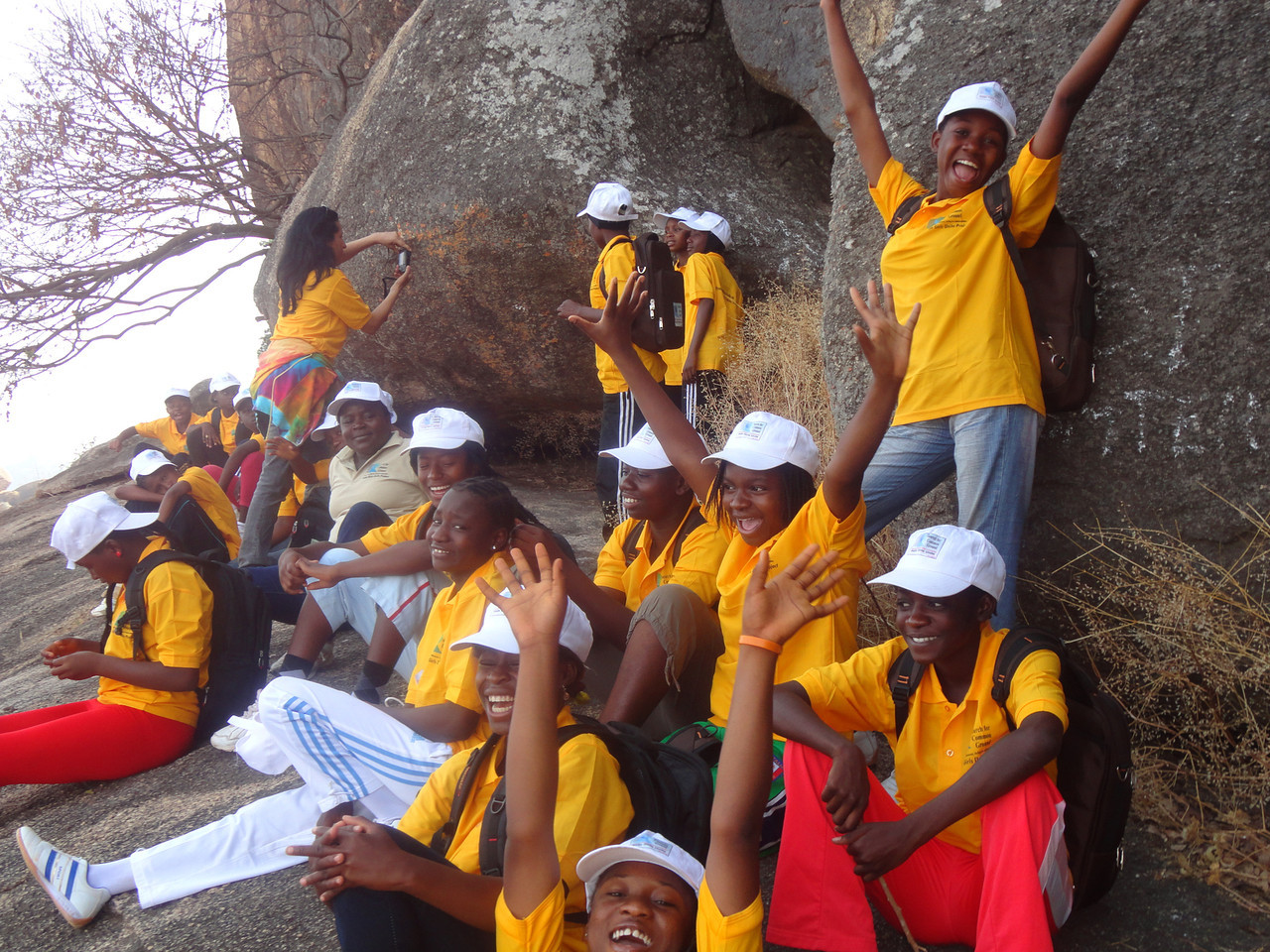
Naija Girls rock-climbing at Shere Hills
The girls also visited local peacebuilding NGOs to learn from their work. During the third and final camp, the girls talked with Commissioner Olivia Dazyam from the Ministry of Woman’s Affairs and Social Development. Mrs. Olivia was very impressed with the girls. She promised her support to the girls’ work in their communities and to visit as many of their events as her schedule would allow.
Now the Naija Girls are spreading the message from the camps to their schoolmates. Fatima’s and Janet’s peace project is only one of many. All over Jos, Naija Girls are running
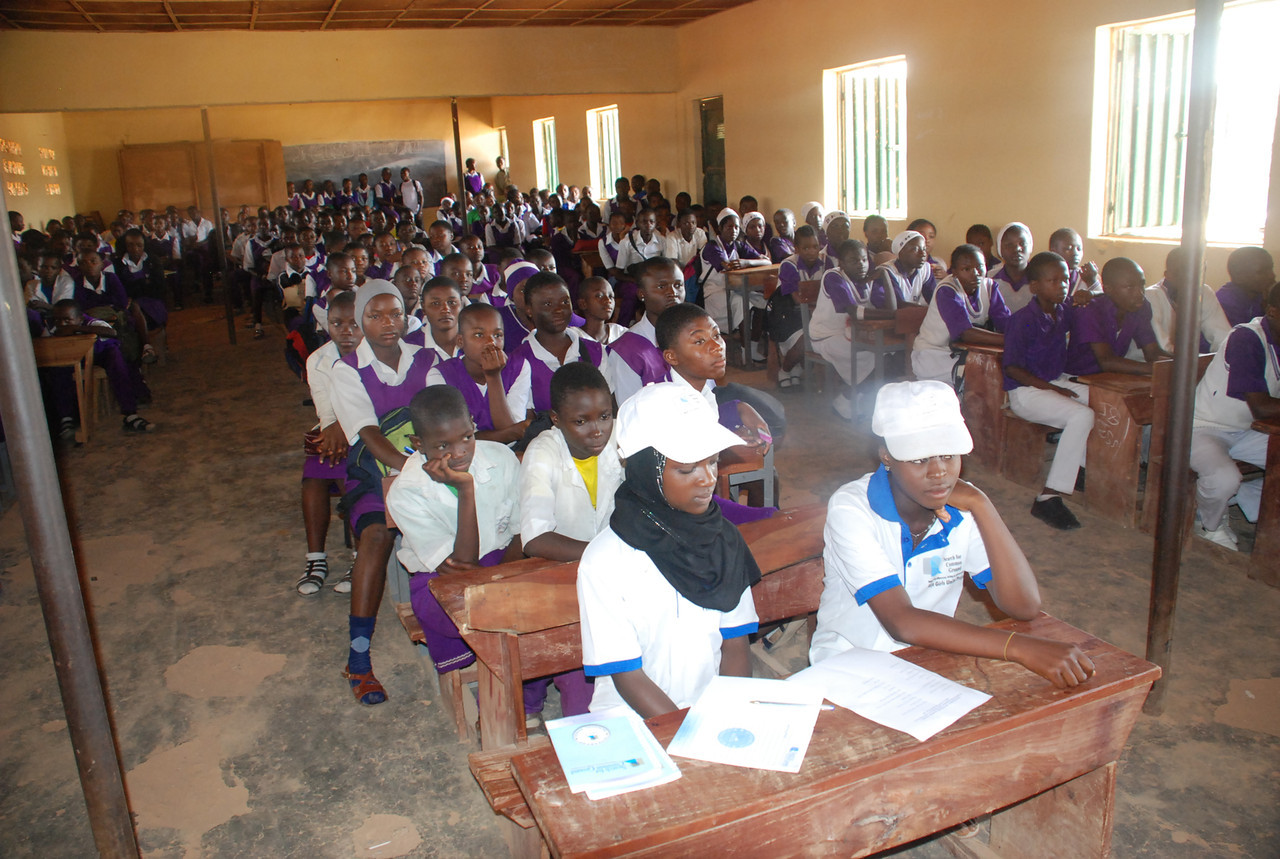
Janet and Fatima waiting anxiously in front of the audience for the event to start
workshops, dramas, talk shows, and peace clubs.
After experiencing today’s event, everybody is very impressed with the girls, and words of appreciation follow the two girls across the schoolyard as they leave. It’s difficult for the girls to hide their pride of today’s event, beaming of joy as they walk away. Over three hundred of Janet’s schoolmates, 20 of her teachers, and a bus load of students from Fatima’s school showed their support.
Next Friday, Janet and students from her school will visit Fatima’s Dadin Kowa School. Originally, the girls planned on presenting peace songs. But since today’s play was such a hit, plans are hastily being made to bring the drama club along.
_____________________________
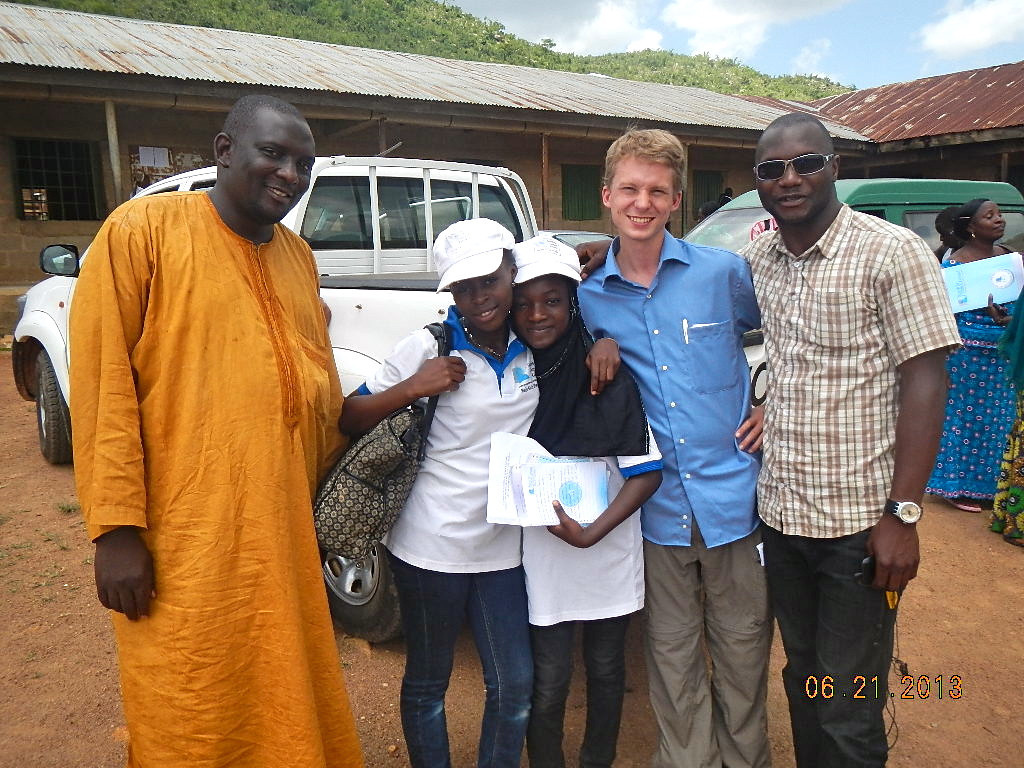
Thomas, Janet, Fatima, Jonas (author of blog) and Joshua
Jonas Holm Klange is an International Intern with SFCG’s Jos office in Nigeria. Jonas is currently pursuing his MA in Political Science at University of Copenhagen having earlier studied Conflict Resolution at Centre of African Studies in Copenhagen and at Sciences Po in Paris. He has traveled extensively throughout Africa, done research in Uganda, Rwanda, Liberia and Sierra Leone and is now working with SFGC Nigeria to build peace on the Plateau.